learngraphtheory.org

Guest User

Using app without sign in

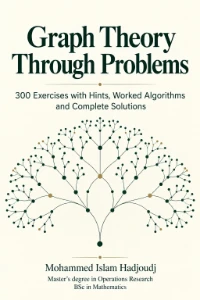
Cover of the book Graph Theory Through Problems

Practice book

Graph Theory Through Problems

300 Exercises with Hints, Worked Algorithms and Complete Solutions

By Mohammed Islam Hadjoudj

Learn graph theory by solving problems: 300 exercises, from routine checks to challenging proofs, each with a complete solution.

Available inKindlePaperback

13 chapters

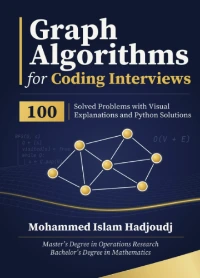
Also by the authorGraph Algorithms for Coding Interviews100 solved interview problems with visual explanations and Python solutions.View on Amazon
Course syllabus

Learning Path

Master graph theory through interactive lessons

12 lectures4 units

0 of 12 completed0%

Available Lessons

Unit IFoundations
0/3
  1. 01Introduction to GraphsA comprehensive introduction to graph theory fundamentals, covering definitions, terminology, types, theorems, and applications.Beginner45 minutes
  2. 02Fundamental Structures in GraphsExplore the essential structures in graphs including paths, walks, trails, cycles, connectivity, components, and the handshaking lemma.Beginner25 minutes
  3. 03Trees and Their ApplicationsExplore trees as fundamental graph structures and their wide-ranging applications in computer science, data organization, and real-world systems.Beginner30 minutes
Unit IITraversal and Paths
0/3
  1. 04Graph Traversal AlgorithmsMaster the fundamental graph traversal techniques and their systematic methods for exploring graph structures.Beginner35 minutes
  2. 05Shortest Path AlgorithmsMaster the fundamental algorithms for finding shortest paths in weighted graphs, including Dijkstra's, Bellman-Ford, A*, and Floyd-Warshall algorithms.Intermediate40 minutes
  3. 06Eulerian and Hamiltonian PathsNewTwo classical traversal questions: when can a walk use every edge exactly once, and when can it visit every vertex exactly once? One is solved in linear time; the other is NP-complete.Intermediate45 minutes
Unit IIIConnectivity and Optimization
0/3
  1. 07Minimum Spanning TreesLearn about minimum spanning trees and the algorithms to find them: Prim's, Kruskal's, and Borůvka's algorithms.Intermediate30 minutes
  2. 08Graph Connectivity and ComponentsA comprehensive exploration of graph connectivity, components, and their applications in network analysis and system design.Advanced40 minutes
  3. 09Network Flow AlgorithmsMaster network flow problems including maximum flow, minimum cut, and their applications in optimization and resource allocation.Advanced45 minutes
Unit IVGraph Structure
0/3
  1. 10Matchings in GraphsNewPairing vertices along edges: augmenting paths and Berge’s theorem, bipartite matching algorithms, Hall’s marriage theorem, König’s theorem and the assignment problem.Advanced50 minutes
  2. 11Graph ColoringNewProper colorings and the chromatic number: bipartite graphs, the bounds ω ≤ χ ≤ Δ + 1, Brooks’ theorem, greedy and DSatur algorithms, edge coloring, and applications to timetabling and register allocation.Intermediate45 minutes
  3. 12Planar GraphsNewGraphs that can be drawn without crossings: Euler’s formula, edge bounds, why K₅ and K₃,₃ are not planar, Kuratowski’s theorem, duality and the five and four color theorems.Advanced50 minutes
Lecture 12Unit IV — Graph Structure

Planar Graphs

Graphs that can be drawn without crossings: Euler’s formula, edge bounds, why K₅ and K₃,₃ are not planar, Kuratowski’s theorem, duality and the five and four color theorems.

Duration
50 minutes
Level
Advanced
Contents
9 sections
Lessons
0 of 9 sections read

Lecture overview

Learning objectives

After this lecture you should be able to:

  1. 1.Define planar graphs, plane embeddings and faces, and prove Euler’s formula V − E + F = 2.
  2. 2.Derive E ≤ 3V − 6 and E ≤ 2V − 4 and use them to show that K₅ and K₃,₃ are not planar.
  3. 3.State Kuratowski’s and Wagner’s characterizations of planar graphs.
  4. 4.Prove that every planar graph is 5-colorable, and relate the Four Color Theorem to map coloring through duality.

Key Concepts

Plane embedding · Faces · Euler’s formula · Edge bounds · K₅ and K₃,₃ · Subdivisions and minors · Kuratowski’s theorem · Dual graph · Five color theorem · Four Color Theorem

1Introduction

Some graphs can be drawn on paper without any two edges crossing; others cannot, however hard we try. The distinction matters whenever a graph has to be realized physically: wires on a single layer of a circuit board must not cross, and neither may roads that meet only at junctions. It also explains why every map can be colored with four colors. This lecture characterizes the graphs that can be drawn without crossings and develops their main properties, starting from a formula Euler stated for polyhedra in the 1750s.

1.1The three utilities puzzle

Three houses must each be connected to three utilities (water, gas and electricity) by pipes that do not cross. The puzzle asks for a crossing-free drawing of the complete bipartite graph K₃,₃. Every attempt ends with one pipe too many; by the end of Section 4 we will be able to prove that no solution exists.

1.2Conventions

Graphs are finite and simple unless stated otherwise. In a drawing of a graph, vertices are distinct points of the plane and edges are curves joining their endpoints. We write V, E and F for the numbers of vertices, edges and faces.
Cover of the book Graph Theory Through Problems

Practice book

Graph Theory Through Problems

300 Exercises with Hints, Worked Algorithms and Complete Solutions

By Mohammed Islam Hadjoudj

Learn graph theory by solving problems: 300 exercises, from routine checks to challenging proofs, each with a complete solution.

  • Hints for every harder exercise, so you can get unstuck
  • Algorithms run by hand, with every step shown in a table
  • From trees and matchings to planar graphs and Ramsey theory
Available inKindlePaperback

13 chapters

Also by the authorGraph Algorithms for Coding Interviews100 solved interview problems with visual explanations and Python solutions.View on Amazon

Section 1 of 9