Lecture overview
Learning objectives
After this lecture you should be able to:
- 1.Distinguish maximal, maximum and perfect matchings, and prove Berge’s augmenting-path theorem.
- 2.Find a maximum bipartite matching with augmenting paths, and explain the O(m√n) bound of Hopcroft–Karp.
- 3.State and prove Hall’s marriage theorem and König’s theorem ν(G) = τ(G) for bipartite graphs.
- 4.Recognize when a problem needs the weighted (Hungarian), general (blossom) or stable (Gale–Shapley) version.
Key Concepts
Matching · Perfect matching · Augmenting path · Berge’s theorem · Hopcroft–Karp · Hall’s theorem · König’s theorem · Vertex cover · Hungarian method · Stable matching
1Introduction
Many practical problems ask us to form pairs: workers with jobs, students with projects, donors with patients, drivers with passengers. When the possible pairs are the edges of a graph, a set of pairs in which nobody is used twice is a matching. This lecture develops the theory of matchings, from Berge's augmenting-path theorem to the theorems of Hall and König, and the algorithms built on them. It connects directly to network flows (Lecture 9) and prepares the ground for edge coloring (Lecture 11).
1.1Notation
Throughout, G = (V, E) is a simple graph with n vertices and m edges. A graph is bipartite with parts X and Y if every edge joins a vertex of X to a vertex of Y. For a set S of vertices, N(S) denotes the set of all neighbors of vertices in S. If A and B are sets, A △ B = (A ∖ B) ∪ (B ∖ A) is their symmetric difference.
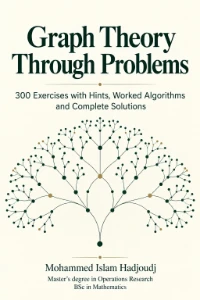
Practice book
Graph Theory Through Problems300 Exercises with Hints, Worked Algorithms and Complete Solutions
By Mohammed Islam Hadjoudj
Learn graph theory by solving problems: 300 exercises, from routine checks to challenging proofs, each with a complete solution.
- Hints for every harder exercise, so you can get unstuck
- Algorithms run by hand, with every step shown in a table
- From trees and matchings to planar graphs and Ramsey theory
 Also by the authorGraph Algorithms for Coding Interviews100 solved interview problems with visual explanations and Python solutions.View on Amazon
Section 1 of 9