learngraphtheory.org

Guest User

Using app without sign in

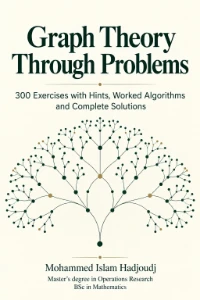
Cover of the book Graph Theory Through Problems

Practice book

Graph Theory Through Problems

300 Exercises with Hints, Worked Algorithms and Complete Solutions

By Mohammed Islam Hadjoudj

Learn graph theory by solving problems: 300 exercises, from routine checks to challenging proofs, each with a complete solution.

Available inKindlePaperback

13 chapters

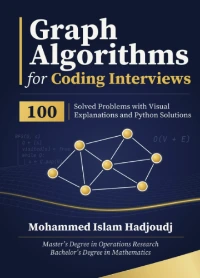
Also by the authorGraph Algorithms for Coding Interviews100 solved interview problems with visual explanations and Python solutions.View on Amazon
Course syllabus

Learning Path

Master graph theory through interactive lessons

12 lectures4 units

0 of 12 completed0%

Available Lessons

Unit IFoundations
0/3
  1. 01Introduction to GraphsA comprehensive introduction to graph theory fundamentals, covering definitions, terminology, types, theorems, and applications.Beginner45 minutes
  2. 02Fundamental Structures in GraphsExplore the essential structures in graphs including paths, walks, trails, cycles, connectivity, components, and the handshaking lemma.Beginner25 minutes
  3. 03Trees and Their ApplicationsExplore trees as fundamental graph structures and their wide-ranging applications in computer science, data organization, and real-world systems.Beginner30 minutes
Unit IITraversal and Paths
0/3
  1. 04Graph Traversal AlgorithmsMaster the fundamental graph traversal techniques and their systematic methods for exploring graph structures.Beginner35 minutes
  2. 05Shortest Path AlgorithmsMaster the fundamental algorithms for finding shortest paths in weighted graphs, including Dijkstra's, Bellman-Ford, A*, and Floyd-Warshall algorithms.Intermediate40 minutes
  3. 06Eulerian and Hamiltonian PathsNewTwo classical traversal questions: when can a walk use every edge exactly once, and when can it visit every vertex exactly once? One is solved in linear time; the other is NP-complete.Intermediate45 minutes
Unit IIIConnectivity and Optimization
0/3
  1. 07Minimum Spanning TreesLearn about minimum spanning trees and the algorithms to find them: Prim's, Kruskal's, and Borůvka's algorithms.Intermediate30 minutes
  2. 08Graph Connectivity and ComponentsA comprehensive exploration of graph connectivity, components, and their applications in network analysis and system design.Advanced40 minutes
  3. 09Network Flow AlgorithmsMaster network flow problems including maximum flow, minimum cut, and their applications in optimization and resource allocation.Advanced45 minutes
Unit IVGraph Structure
0/3
  1. 10Matchings in GraphsNewPairing vertices along edges: augmenting paths and Berge’s theorem, bipartite matching algorithms, Hall’s marriage theorem, König’s theorem and the assignment problem.Advanced50 minutes
  2. 11Graph ColoringNewProper colorings and the chromatic number: bipartite graphs, the bounds ω ≤ χ ≤ Δ + 1, Brooks’ theorem, greedy and DSatur algorithms, edge coloring, and applications to timetabling and register allocation.Intermediate45 minutes
  3. 12Planar GraphsNewGraphs that can be drawn without crossings: Euler’s formula, edge bounds, why K₅ and K₃,₃ are not planar, Kuratowski’s theorem, duality and the five and four color theorems.Advanced50 minutes
Lecture 06Unit II — Traversal and Paths

Eulerian and Hamiltonian Paths

Two classical traversal questions: when can a walk use every edge exactly once, and when can it visit every vertex exactly once? One is solved in linear time; the other is NP-complete.

Duration
45 minutes
Level
Intermediate
Contents
7 sections
Lessons
0 of 7 sections read

Lecture overview

Learning objectives

After this lecture you should be able to:

  1. 1.Decide from the vertex degrees whether a graph has an Eulerian circuit or trail, and prove why.
  2. 2.Construct an Eulerian circuit in linear time with Hierholzer’s algorithm.
  3. 3.State the sufficient conditions of Ore and Dirac for Hamiltonian cycles, and a necessary condition for proving that a graph is not Hamiltonian.
  4. 4.Explain why the Eulerian problem is easy while the Hamiltonian and travelling salesman problems are NP-hard.

Key Concepts

Eulerian trail · Eulerian circuit · Euler’s theorem · Hierholzer’s algorithm · Hamiltonian cycle · Ore’s theorem · Dirac’s theorem · NP-completeness · Chinese postman

1Introduction

Two questions about a graph look almost identical. Can we travel through it using every edge exactly once? Can we travel through it visiting every vertex exactly once? The first question was answered completely by Leonhard Euler in 1736, in the paper usually taken as the beginning of graph theory. The second looks no harder, yet no efficient answer is known, and it is one of the classic NP-complete problems. This lecture treats both, and the contrast between them is its main lesson.

1.1The Königsberg bridge problem

The Prussian city of Königsberg (today Kaliningrad) stood on both banks of the river Pregel and on two islands, joined by seven bridges. Its citizens asked whether one could take a walk that crosses every bridge exactly once.

Euler replaced each of the four land masses by a vertex and each bridge by an edge. The result is a multigraph with four vertices and seven edges whose degrees are 5, 3, 3 and 3. Euler showed that such a walk is impossible, and his argument gives the rule for every graph, which we prove in Section 2.

1.2Conventions

In this lecture graphs may have parallel edges (as Königsberg does) but no loops. Recall from Lecture 2 that a trail is a walk that repeats no edge and a path is a walk that repeats no vertex. We write n = |V| and m = |E|.
Cover of the book Graph Theory Through Problems

Practice book

Graph Theory Through Problems

300 Exercises with Hints, Worked Algorithms and Complete Solutions

By Mohammed Islam Hadjoudj

Learn graph theory by solving problems: 300 exercises, from routine checks to challenging proofs, each with a complete solution.

  • Hints for every harder exercise, so you can get unstuck
  • Algorithms run by hand, with every step shown in a table
  • From trees and matchings to planar graphs and Ramsey theory
Available inKindlePaperback

13 chapters

Also by the authorGraph Algorithms for Coding Interviews100 solved interview problems with visual explanations and Python solutions.View on Amazon

Section 1 of 7