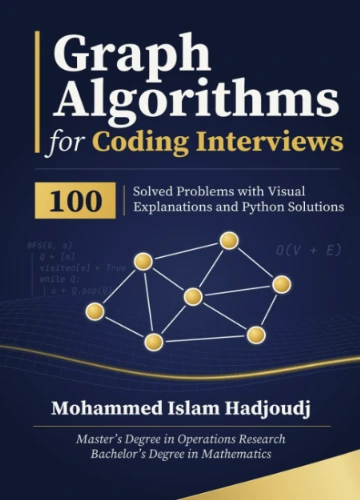
About the Book
Graph Algorithms for Coding Interviews prepares you for the graph questions in technical interviews with 100 solved problems. Every problem comes with a visual explanation that shows the algorithm step by step and a complete Python solution.
Graph questions are where many candidates freeze: the problem talks about courses, islands, flights or friends, and the graph is hidden in the story. The way through is practice with feedback. You need to see enough problems to recognise the pattern, and you need to see each algorithm move before you can trust your own code under pressure. This book gives you both.
- 100 solved problems on graphs, written as interview questions.
- Visual explanations that show each algorithm step by step, so you see why it works, not only the code.
- A complete Python solution for every problem.
- Written by the creator of learngraphtheory.org, the interactive graph algorithm visualizer.
Who It Is For
- Candidates preparing for software engineering interviews who want to stop dreading the graph round.
- Computer science students who learned BFS, DFS and Dijkstra in class and now need to apply them to unfamiliar problems.
- Working engineers refreshing their algorithms before a job change.
- Visual learners who understand an algorithm best when they can see it run.
What a Problem Looks Like
Here is a classic interview problem worked in the style of the book, written for this page: the problem, the picture that cracks it, and the Python solution.
Can you finish all the courses?
There are n courses, numbered 0 to n − 1. Each pair [a, b] in prerequisites means you must take course b before course a. Return True if you can finish every course.
Spot the graph. Courses are vertices and each prerequisite is a directed edge b → a. You can finish everything exactly when this directed graph has no cycle, so the question is really: does a topological order exist?
The idea (Kahn's algorithm). Repeatedly take a course whose prerequisites are all done (in-degree 0), and remove its outgoing edges. If you manage to take all n courses, there is no cycle. If you get stuck early, the courses left over sit on a cycle.
| Take | In-degrees after (0, 1, 2, 3) | Queue |
|---|---|---|
| – | 0, 1, 1, 2 | [0] |
| 0 | –, 0, 0, 2 | [1, 2] |
| 1 | –, –, 0, 1 | [2] |
| 2 | –, –, –, 0 | [3] |
| 3 | –, –, –, – | [] |
All four courses are taken, so the answer is True. Add the pair [1, 3] and courses 1 and 3 wait for each other: after taking 0 and 2 the queue is empty, only 2 of 4 courses are done, and the answer is False.
from collections import deque

def can_finish(n, prerequisites):
    graph = [[] for _ in range(n)]
    indegree = [0] * n
    for course, before in prerequisites:
        graph[before].append(course)
        indegree[course] += 1

    queue = deque(v for v in range(n) if indegree[v] == 0)
    taken = 0
    while queue:
        v = queue.popleft()
        taken += 1
        for w in graph[v]:
            indegree[w] -= 1
            if indegree[w] == 0:
                queue.append(w)
    return taken == n


print(can_finish(4, [[1, 0], [2, 0], [3, 1], [3, 2]]))          # True
print(can_finish(4, [[1, 0], [2, 0], [3, 1], [3, 2], [1, 3]]))  # False
Complexity. Every course enters the queue at most once and every edge is looked at once, so the time is O(V + E) and the extra space is O(V + E) for the adjacency list. See it run in the topological sort visualizer.
Free Practice on This Site
Use these free pages next to the book: question lists to test yourself, and visualizers to watch an algorithm run on your own graph.
| Pattern | Interview questions | Watch it run |
|---|---|---|
| Breadth-first search | BFS interview questions | BFS visualizer |
| Depth-first search | DFS interview questions | DFS visualizer |
| Topological sort | Topological sort questions | Topological sort visualizer |
| Shortest paths | Dijkstra interview questions | Dijkstra visualizer |
| Union-find | Union-find questions | Kruskal visualizer |
| Max flow and min cut | Max flow questions | Max flow visualizer |
For a one-page review the night before, keep the graph algorithms cheat sheet and the complexity table open, and read which graph algorithms come up in interviews.
Which of the Two Books Is for You?
Mohammed Islam Hadjoudj has written two graph books with different jobs. Pick by what you need to do next.
| Graph Theory Through Problems | Graph Algorithms for Coding Interviews | |
|---|---|---|
| Goal | Understand the theory and pass a graph theory course or exam | Solve graph questions in technical interviews |
| Contents | 300 exercises over 13 chapters | 100 solved interview problems |
| Support | Hints for the harder exercises and a complete solution to every one | A visual explanation and a Python solution for every problem |
| Style | Proofs, and algorithms run by hand in step tables | Code you can run and adapt |
| Formats | Kindle and paperback | Kindle and paperback |
About the Author

Mohammed Islam Hadjoudj holds a Master's degree in Operations Research and a Bachelor's degree in Mathematics, built Learn Graph Theory (the free interactive visualizer, lessons and article library on this site) and works on combinatorial optimization and scheduling problems.
Frequently Asked Questions
What language are the solutions in?
Python. Every one of the 100 problems has a complete Python solution.
How many problems are in Graph Algorithms for Coding Interviews?
100 solved problems, each with a visual explanation that shows the algorithm step by step and a complete Python solution.
Is it available on Kindle?
Yes. The book is available as a Kindle ebook and as a paperback on Amazon.
How is it different from practising on LeetCode?
Coding sites give you problems and a judge. This book explains each problem: it shows the algorithm moving step by step in pictures and walks through a complete solution, so you learn the pattern and not only the accepted answer. The two work well together.
Who wrote Graph Algorithms for Coding Interviews?
Mohammed Islam Hadjoudj, who holds a Master's degree in Operations Research and a Bachelor's degree in Mathematics and created the Learn Graph Theory website and its interactive algorithm visualizer.
Disclosure: this page is written by the author of the book, who also runs this site. Example problems on this page were written for this page to show the style of the book.