
Table of Contents
1. What Is Spectral Graph Theory?
Spectral graph theory studies a graph through the eigenvalues and eigenvectors of matrices that represent it. Rather than reasoning about vertices and edges one at a time, we encode the whole graph as a matrix and read its structure from that matrix's spectrum, its collection of eigenvalues. It is the bridge that connects discrete, combinatorial objects to the continuous, well-developed machinery of linear algebra.
This bridge is exactly why machine learning cares. Real data is overwhelmingly relational: social networks, molecules, citation graphs, road maps, the pixels of an image, and the co-occurrence of words. Yet most learning algorithms expect tidy numerical vectors as input. Spectral methods resolve that tension by turning a graph into coordinates, geometry you can cluster, embed, and feed to a neural network.
The field has deep roots in pure mathematics (the work of Fiedler, Chung, and others) but has become a practical toolkit. As Daniel Spielman puts it in his widely used Yale lecture notes, the spectrum reveals "how well connected a graph is, whether it has good clusters, and how information diffuses across it." Those three questions sit at the heart of unsupervised learning.
2. From Graph to Matrix: The Laplacian
Three matrices describe a graph with n vertices. The adjacency matrix A has a 1 in entry (i, j) when an edge joins vertices i and j. The degree matrix D is diagonal, holding each vertex's degree. The star of the show is the graph Laplacian:
L = D − A
The Laplacian is symmetric and positive semi-definite, its rows each sum to zero, and it behaves as a discrete version of the Laplace operator from physics, it measures how much a signal on the graph varies from node to neighbouring node. That intuition is captured by its quadratic form, xᵀLx = Σ (xᵢ − xⱼ)² summed over every edge: small when connected vertices share similar values, large when they disagree.
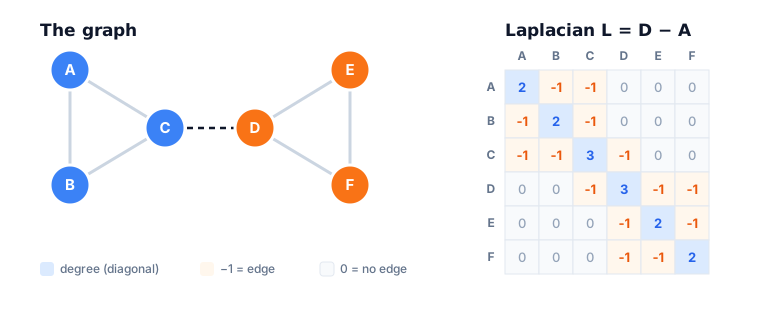
In practice you usually prefer a normalized Laplacian, which rescales for uneven degrees. The symmetric version is L_sym = I − D^(−1/2) A D^(−1/2) and the random-walk version is L_rw = I − D^(−1) A. Normalization keeps high-degree hubs from dominating the spectrum, and most machine-learning recipes, spectral clustering and Graph Neural Networks alike, are built on these normalized forms.
3. The Graph Spectrum: Eigenvalues as Structure
Because the Laplacian is symmetric and positive semi-definite, all of its eigenvalues are real and non-negative. We order them 0 = λ₁ ≤ λ₂ ≤ … ≤ λₙ. This ordered list is the graph's spectrum, and it is astonishingly informative.
- The smallest eigenvalue is always 0, with the constant vector as its eigenvector.
- The number of zero eigenvalues equals the number of connected components. A single 0 means the graph is connected.
- The second-smallest eigenvalue
λ₂is the celebrated algebraic connectivity, or Fiedler value (Miroslav Fiedler, 1973). The closer it is to zero, the more easily the graph splits into two pieces.
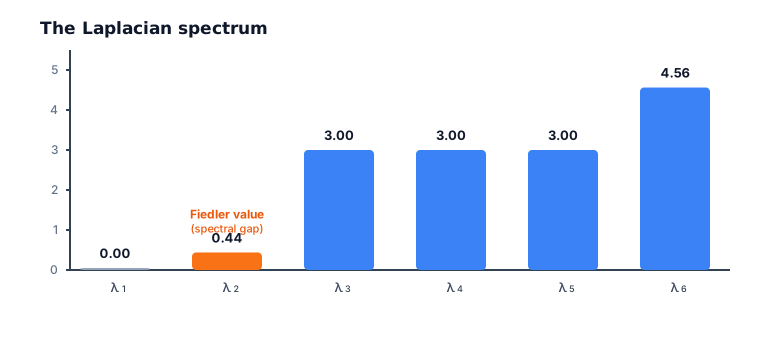
The jump from λ₂ to λ₃ is called the spectral gap, and a large gap is a strong hint that the graph has a clean cluster structure. The eigenvector belonging to λ₂, the Fiedler vector, assigns each vertex a number whose sign tells you which side of the cut it falls on. The famous Cheeger inequality makes this rigorous, bounding a graph's sparsest cut in terms of λ₂. In one number, the spectrum answers: is this data one blob, or several?
4. Spectral Clustering
Spectral clustering is the flagship machine-learning application, and it follows directly from the previous section. The recipe is short:
- Build a similarity graph from your data, typically a k-nearest-neighbour graph or a Gaussian (RBF) kernel that connects nearby points.
- Form the normalized Laplacian and compute its k smallest eigenvectors.
- Stack those eigenvectors as columns to give each point a new k-dimensional coordinate, the spectral embedding.
- Run ordinary k-means in that embedded space.
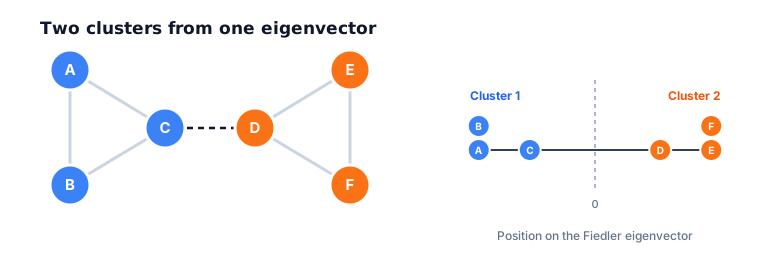
Why bother, when k-means already exists? Because k-means can only carve out round, convex blobs, while spectral clustering can recover arbitrarily shaped clusters, the classic "two interlocking moons" or concentric rings that defeat k-means entirely. Mathematically, it is a tractable relaxation of the normalized-cut problem, which is NP-hard in its exact form; the eigenvectors give the best continuous approximation. The approach was popularised by Shi and Malik's Normalized Cuts for image segmentation (2000) and by Ng, Jordan, and Weiss (2002), and Ulrike von Luxburg's 2007 tutorial remains the definitive practical guide.
A canonical demonstration is the "two moons" dataset, two interleaving crescent shapes. Plain k-means slices it straight down the middle and fails, because the crescents are not linearly separable. Spectral clustering, working on the neighbourhood graph, follows the curve of each moon and recovers both correctly. The same advantage shows up with concentric circles and any data whose clusters are connected but not compact.
See the Spectrum in Action
Build a graph, then watch its Laplacian, eigenvalues, and Fiedler vector update live, and see exactly how the spectrum splits a network into clusters.
Launch the Visualizer5. Manifold Learning and Laplacian Eigenmaps
The same eigenvectors that cut a graph can also flatten high-dimensional data. This is the idea behind Laplacian Eigenmaps, introduced by Mikhail Belkin and Partha Niyogi in 2003. The premise, the manifold hypothesis, is that real high-dimensional data (faces, handwriting, gene expression) actually lives on a much lower-dimensional curved surface embedded in that space.
Laplacian Eigenmaps recover that surface by building a neighbourhood graph and then choosing low-dimensional coordinates y that minimise Σ wᵢⱼ ‖yᵢ − yⱼ‖², keeping points that were close in the original space close in the embedding. The solution is, once again, the smallest non-trivial eigenvectors of the graph Laplacian. Unlike PCA, which can only find linear projections, this is genuinely non-linear dimensionality reduction, and it is closely related to diffusion maps and to spectral embedding as shipped in scikit-learn. It is a workhorse for visualisation and for preprocessing before classification.
It is worth separating these methods from t-SNE and UMAP, the popular visualisation tools. Those are also graph-based and neighbourhood-preserving in spirit, but they optimise a probabilistic objective rather than solving directly for Laplacian eigenvectors. Laplacian Eigenmaps stay attractive when you want a fast, deterministic embedding with a transparent linear-algebra interpretation.
6. Spectral Graph Neural Networks
Spectral graph theory is also the theoretical foundation of an entire branch of deep learning. The key idea is the graph Fourier transform: projecting a signal defined on the vertices onto the Laplacian's eigenvectors plays the same role that the classical Fourier transform plays for time series. The eigenvalues act as frequencies, and "filtering" a graph signal means reweighting its spectral components.
Bruna and colleagues defined the first spectral convolution on graphs this way in 2014. It worked, but a full eigendecomposition costs O(n³) and the filters were not localised. Two refinements made the idea practical:
- ChebNet (Defferrard, Bresson, and Vandergheynst, NeurIPS 2016) approximates spectral filters with Chebyshev polynomials of the Laplacian. This makes filters strictly local and runs in time linear in the number of edges, no eigendecomposition required.
- The Graph Convolutional Network (Kipf & Welling, ICLR 2017) simplifies ChebNet to a first-order form, yielding the now-ubiquitous propagation rule
H' = σ( D̃^(−1/2) à D̃^(−1/2) H W ), whereà = A + Iadds self-loops.
That single elegant layer, a direct descendant of the normalized Laplacian, is what powers today's GNN applications in recommendation systems, fraud detection, traffic forecasting, and drug and materials discovery.
One practical caveat: a purely spectral filter is tied to a single fixed graph, because the eigenvectors change the moment the graph does. That is why much of the field has shifted toward spatial message-passing networks, which generalise across graphs of different sizes. Even so, the spectral viewpoint remains the clearest lens for understanding what a graph convolution actually does to a signal.
7. Tools and When to Use Spectral Methods
You rarely implement the linear algebra by hand. Mature, trusted libraries cover the whole pipeline:
- scikit-learn,
SpectralClusteringandSpectralEmbeddingfor clustering and manifold learning. - NetworkX,
laplacian_matrix,normalized_laplacian_matrix, andfiedler_vectorfor analysis. - SciPy,
scipy.sparse.linalg.eigshto compute just the few smallest eigenvectors of a large sparse Laplacian efficiently. - PyTorch Geometric and DGL, production GNN layers including GCN and ChebNet.
A few practical rules of thumb: always work with the normalized Laplacian; use sparse eigensolvers and ask only for the smallest eigenvectors you need; and choose the number of clusters with the eigengap heuristic, look for the largest jump in the sorted spectrum. Reach for spectral methods when your data is naturally a graph, when clusters are non-convex, or when you need a principled low-dimensional embedding. When clusters are clearly round and the data is already vectorised, plain k-means may be faster and just as good. Spectral graph theory does not replace your toolbox, it gives it geometry.
At a Glance: Choosing a Method
| Method | What it needs | Strength | Typical use |
|---|---|---|---|
| k-means | Feature vectors | Simple and fast | Round clusters, quick baselines |
| Spectral clustering | A similarity graph | Finds non-convex clusters | Community detection, image segmentation |
| Laplacian eigenmaps | A neighbourhood graph | Non-linear embedding | Visualisation, preprocessing |
| Spectral GNN (GCN / ChebNet) | Graph + node features | Learns from structure and features | Node classification, recommendations |
Frequently Asked Questions
What is the graph Laplacian in simple terms?
The Laplacian is the matrix L = D − A, where D holds vertex degrees on its diagonal and A is the adjacency matrix. It measures how much a signal changes from each node to its neighbours, and its eigenvalues and eigenvectors reveal the graph’s connectivity and cluster structure.
Why is the second-smallest eigenvalue (the Fiedler value) important?
The Fiedler value, or algebraic connectivity, measures how well connected a graph is. A value near zero means the graph nearly separates into two components, and the corresponding Fiedler vector tells you how to make that split, which is the basis of spectral clustering.
How is spectral clustering different from k-means?
k-means can only find round, convex clusters in the original feature space. Spectral clustering first re-embeds the data using Laplacian eigenvectors, so it can recover arbitrarily shaped clusters, such as nested rings or interleaved moons, before applying k-means in that new space.
Are Graph Neural Networks based on spectral graph theory?
Spectral GNNs are. The graph Fourier transform uses Laplacian eigenvectors as a frequency basis; ChebNet approximates spectral filters with Chebyshev polynomials, and the popular GCN of Kipf and Welling is a first-order simplification of that spectral construction.