
Table of Contents
- 1. The Birth (1736): The Seven Bridges of Königsberg
- 2. The 19th Century: Hamilton, Kirchhoff, and Trees
- 3. The Century-Long Battle: The Four Color Theorem
- 4. The Probabilistic Revolution: Erdős and Rényi
- 5. The Modern Era: Algorithms, Networks, and Machine Learning
- 6. Conclusion: A Branch that Connects Everything
1. The Birth (1736): The Seven Bridges of Königsberg
Unlike many fields of mathematics that developed slowly over centuries from ancient Greek or Indian traditions, the exact birthplace and birthdate of graph theory are undisputed. It was born in 1736 from the mind of a single genius: Leonhard Euler.
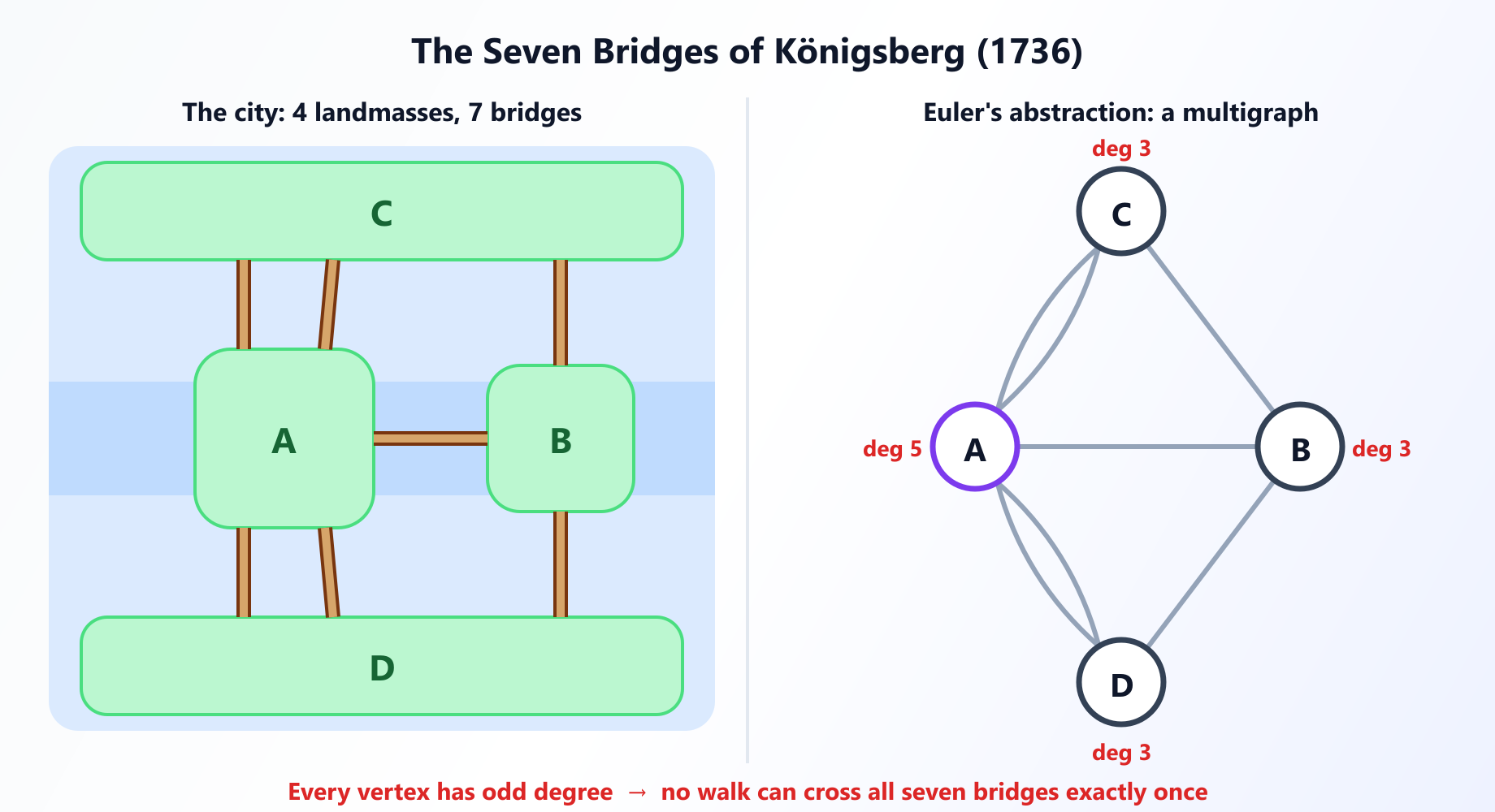
At the time, the Prussian city of Königsberg (now Kaliningrad, Russia) was situated on both sides of the Pregel River, and included two large islands. These four landmasses were connected to each other by exactly seven bridges.
The citizens of Königsberg had created a local puzzle, a piece of urban folklore: Was it possible to take a walk through the city, crossing every single one of the seven bridges exactly once, and return to the starting point?
Despite numerous attempts, no one could find such a path, nor could anyone definitively prove it was impossible. In 1735, the problem was brought to the attention of Euler, who was working at the St. Petersburg Academy.
Euler's Abstraction
Euler's genius lay not just in solving the problem, but in realizing what information was irrelevant. He recognized that the exact physical geography, the size of the islands, the length of the bridges, the distance between them, mattered not at all. The only thing that mattered was the connections.
He abstracted the map: the four landmasses became points (what we now call vertices or nodes), and the seven bridges became lines connecting them (what we now call edges).
In his seminal 1736 paper, "Solutio Problematis ad Geometriam Situs Pertinentis" (The solution of a problem relating to the geometry of position), Euler proved the walk was impossible. He reasoned that when you enter a landmass by a bridge, you must leave it by another bridge. Therefore, every landmass must have an even number of bridges connected to it (unless it is the starting or ending point). Since all four landmasses in Königsberg had an odd number of bridges connected to them, the path could not exist.
By shifting focus from distance and measurement to connections and relative positions, Euler inadvertently founded not only Graph Theory but also laid the conceptual foundations for Topology.
2. The 19th Century: Hamilton, Kirchhoff, and Trees
For roughly a century after Euler's paper, graph theory saw minimal development. It was viewed mostly as a collection of recreational puzzles rather than a serious branch of mathematics. However, in the 19th century, graph theory began to find applications in other scientific disciplines.
Trees and Chemistry
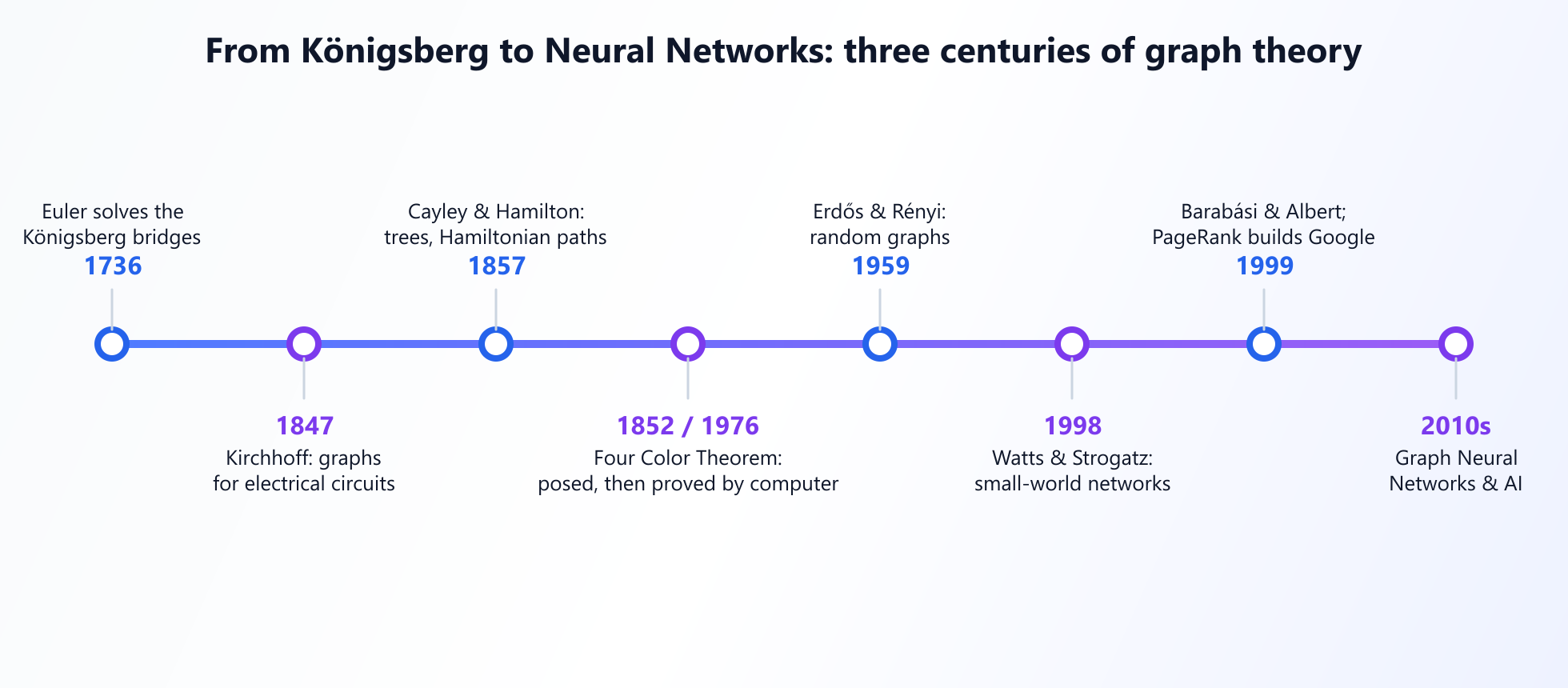
In 1857, the British mathematician Arthur Cayley utilized a specific type of graph, a connected graph with no cycles, which he called a tree, to count the number of isomers of alkanes in theoretical chemistry. It was also around this time, in 1878, that the mathematician James Joseph Sylvester first officially used the term "graph" in the mathematical sense, drawing an analogy between chemical bonds and mathematical connections.
Electrical Circuits
In 1847, the German physicist Gustav Kirchhoff applied graph theory concepts to electrical circuits. To calculate the voltage and current in each branch of a complex electrical network, Kirchhoff developed laws that fundamentally relied on finding a spanning tree of the circuit graph. This was one of the earliest instances of graph theory being applied to serious engineering problems.
The Icosian Game and Hamiltonian Paths
In 1857, Irish mathematician Sir William Rowan Hamilton invented the "Icosian game," a puzzle sold as a wooden dodecahedron with a peg at each vertex. The goal was to find a path that visited every vertex exactly once and returned to the start. While Euler studied paths that visited every edge exactly once (now called Eulerian paths), paths that visit every vertex exactly once are now forever known as Hamiltonian paths. Determining whether a Hamiltonian path exists remains, to this day, an intensely difficult computational problem (NP-complete).
3. The Century-Long Battle: The Four Color Theorem
Perhaps no problem drove the development of graph theory more than the famous Four Color Conjecture. The problem was first proposed in 1852 by Francis Guthrie, while trying to color the map of counties of England.
The conjecture simply states: Given any separation of a plane into contiguous regions (like a political map of countries), the regions can be colored using at most four colors so that no two adjacent regions have the same color.
This problem translates perfectly into graph theory: if every region is a vertex, and an edge connects regions that share a border, can you color the vertices using only four colors such that no two connected vertices share a color?
False Starts and Frustration
The problem seems deceptively simple. In 1879, Alfred Kempe published a proof that was widely accepted. Eleven years later, in 1890, Percy Heawood found a fatal flaw in Kempe's proof (though Heawood was able to salvage the proof to prove the Five Color Theorem). In 1880, Peter Tait published a different proof; eleven years later, Julius Petersen found a flaw in that one as well.
For decades, the brightest mathematical minds failed to prove the Four Color Conjecture, driving significant advancements in the study of planar graphs, vertex coloring, and chromatic polynomials.
The Computer-Assisted Breakthrough
Finally, in 1976, mathematicians Kenneth Appel and Wolfgang Haken provided a proof. However, it was highly controversial. Their proof reduced the infinite possible maps down to 1,936 reducible configurations (later refined to 633). To verify that every single configuration was colorable, they relied on over 1,000 hours of computer calculation.
This was the first major mathematical theorem proven using a computer. It sparked a massive philosophical debate in the mathematical community. If a human cannot independently verify the steps, is it truly a mathematical proof? Today, computer-assisted proofs are widely accepted, but the Four Color Theorem remains a defining moment in the history of mathematics.
Interactive Graph Coloring
Want to try to color a complex map with only 3 or 4 colors? Use our interactive Graph Coloring visualizer to understand why vertex coloring is such a complex algorithmic challenge.
Launch Coloring Visualizer4. The Probabilistic Revolution: Erdős and Rényi
For over two hundred years, graph theory focused on static, deterministic structures. If you had a specific graph, you asked specific questions about it. But in the late 1950s, the field experienced a monumental paradigm shift thanks to the brilliant Hungarian mathematicians Paul Erdős and Alfréd Rényi.
They introduced the concept of Random Graphs, transforming graph theory from a purely structural discipline into a probabilistic and statistical science.
The Erdős–Rényi Model
They proposed a simple model: take n vertices. For every possible pair of vertices, flip a biased coin. With probability p, draw an edge between them. With probability 1 - p, do not.
Instead of asking "does this graph have a Hamiltonian path?", mathematicians began asking, "what is the probability that a random graph has a Hamiltonian path?"
Phase Transitions and the Giant Component
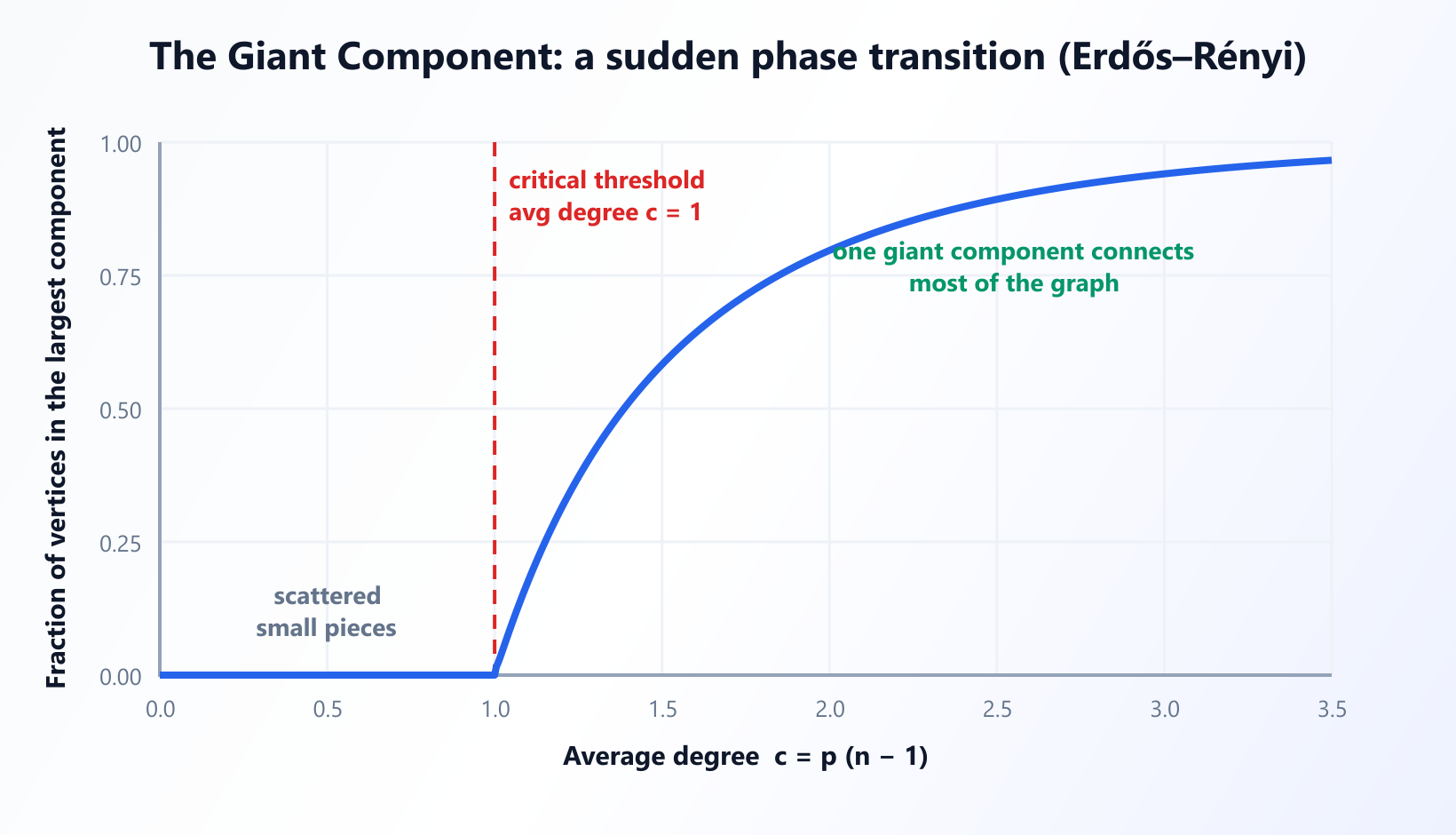
Erdős and Rényi discovered something breathtaking. As you slowly increase the probability p of edges forming, properties don't appear gradually, they appear suddenly. They discovered sudden phase transitions, much like water suddenly freezing into ice at exactly zero degrees.
For instance, if p is small, the graph is a scattered collection of small, disconnected components. But the moment p crosses a specific critical threshold, a "Giant Component" abruptly emerges, instantly connecting a massive fraction of all vertices into a single network. This mathematical discovery proved to be fundamental for understanding everything from the spread of infectious diseases to the resilience of the internet.
5. The Modern Era: Algorithms, Networks, and Machine Learning
With the advent of the computer age in the latter half of the 20th century, graph theory exploded. It moved from abstract mathematics to the absolute core of computer science.
The Algorithmic Boom (1950s - 1980s)
As computers became capable of processing large datasets, researchers focused intensely on developing efficient algorithms to traverse and manipulate graphs. Edsger W. Dijkstra published his famous Shortest Path algorithm in 1959. Ford and Fulkerson published their Max-Flow algorithm in 1956. Robert Tarjan developed linear-time algorithms for finding strongly connected components and articulation points in the 1970s.
Network Science and The Web (1990s - 2000s)
As the internet grew, researchers realized that the Erdős-Rényi random graph model did not accurately describe real-world networks. Real networks, like the World Wide Web or human social networks, are not purely random.
In 1999, Albert-László Barabási and Réka Albert introduced the Scale-Free Network model, characterized by the presence of highly connected "hubs." At the same time, Duncan Watts and Steven Strogatz formalized the "Small-World" phenomenon (the six degrees of separation).
Perhaps the most famous modern application of graph theory was Larry Page and Sergey Brin's PageRank algorithm, which fundamentally treated the entire World Wide Web as a massive directed graph, using eigenvector centrality to rank the importance of websites and birth the Google search engine.
Graph Neural Networks (2010s - Present)
Today, graph theory has merged with artificial intelligence. Standard neural networks struggle with unstructured, asymmetric data. Graph Neural Networks (GNNs) were developed to allow machine learning models to directly process graph structures.
GNNs are currently driving massive breakthroughs in drug discovery (by treating molecules as graphs of atoms), traffic prediction (by treating road networks as graphs), and recommendation systems (by modeling user-item interactions as bipartite graphs).
6. Conclusion: A Branch that Connects Everything
The history of graph theory is a testament to the power of mathematical abstraction. What began as an effort to solve a trivial puzzle about bridges over a river in Prussia has evolved into the definitive mathematical language for describing complex relationships.
From mapping the intricate wiring of the human brain (the connectome) to optimizing global supply chains, from finding the fastest route home on Google Maps to discovering the chemical structures of new antibiotics, graph theory remains the invisible architecture of our deeply connected world.
Frequently Asked Questions
Who is credited with founding graph theory?
Swiss mathematician Leonhard Euler is considered the father of graph theory, starting with his historic paper solving the Königsberg bridge problem in 1736.
What was the Seven Bridges of Königsberg puzzle?
A puzzle asking if one could walk through the city of Königsberg crossing all seven of its bridges exactly once. Euler proved mathematically that this is impossible.
Why is the Four Color Theorem historically significant?
Proposed in 1852 and solved in 1976, it was the first major mathematical theorem to be proven using a computer program, sparking significant philosophical discussions on computerized proofs.