
Table of Contents
- 1. Introduction to Computational Complexity in Graphs
- 2. Graph Representation: The Silent Complexity Modifier
- 3. Graph Traversal Algorithms (BFS & DFS)
- 4. Shortest Path Algorithms
- 5. Minimum Spanning Tree Algorithms
- 6. Connectivity and Topological Sorting
- 7. Network Flow Algorithms
- 8. NP-Hard Graph Problems
- 9. The Ultimate Complexity Cheat Sheet
1. Introduction to Computational Complexity in Graphs
In computer science, algorithms are rarely judged solely on whether they produce the correct result. They are judged on how efficiently they produce that result. As data scales, whether you're analyzing a social network with billions of users or calculating logistics for global shipping routes, efficiency becomes the ultimate bottleneck.
We measure efficiency using Big O Notation, which provides an upper bound on the time (execution speed) and space (memory consumption) an algorithm requires, relative to the size of its input. In graph theory, the input size is almost always defined by two parameters:
V(or|V|): The number of Vertices (nodes) in the graph.E(or|E|): The number of Edges (connections) in the graph.
A graph can be Sparse (where E is close to V) or Dense (where E is close to V²). The sparsity or density of a graph heavily dictates which algorithms, and which data structures, will perform optimally.
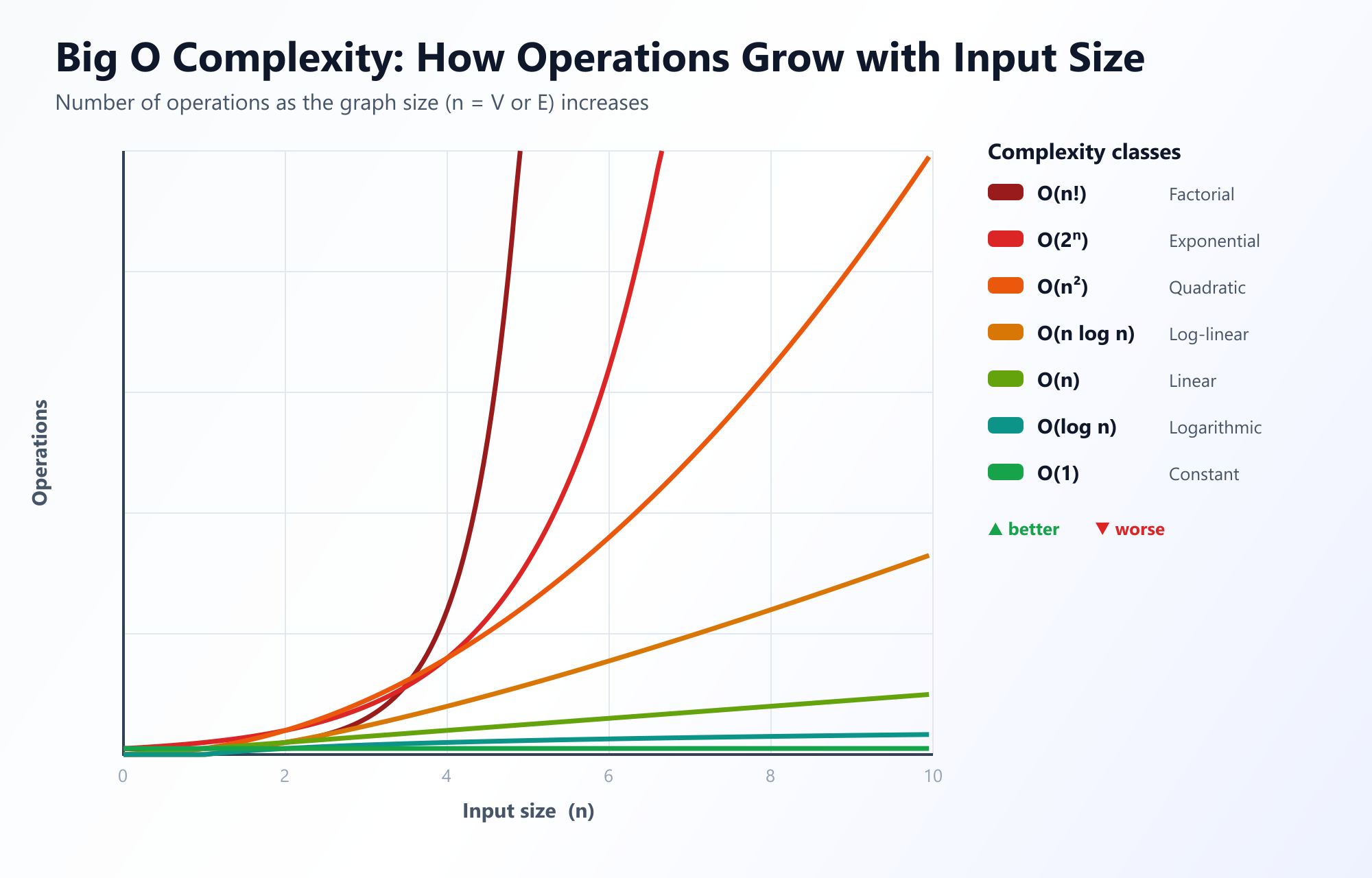
Rule of Thumb: If an algorithm operates in O(V²) time, it might be acceptable for a graph with 1,000 vertices (1,000,000 operations). But for a graph with 1,000,000 vertices, it requires 1,000,000,000,000 operations, rendering it completely useless for real-time applications. Understanding asymptotic complexity is non-negotiable for system design.
2. Graph Representation: The Silent Complexity Modifier
Before analyzing any specific algorithm, we must discuss graph representation. How you store a graph in memory fundamentally alters the time and space complexity of every operation performed on it. The two most common representations are the Adjacency Matrix and the Adjacency List.
Adjacency Matrix
An adjacency matrix is a 2D array of size V × V. A cell at matrix[i][j] holds a boolean (or a weight) indicating if an edge exists from vertex i to vertex j.
- Space Complexity:
O(V²). This is extremely memory-intensive. For a graph with 100,000 nodes, the matrix requires 10 billion entries. - Edge Lookup (Are i and j connected?):
O(1). Immediate verification. - Finding all neighbors of a vertex:
O(V). You must iterate through the entire row for that vertex, checking all possible connections, even if the graph is sparse.
Adjacency List
An adjacency list is an array (or hash map) of lists. The index represents the vertex, and the list at that index contains all of its connected neighbors.
- Space Complexity:
O(V + E). This is optimal because it only stores the vertices and the actual edges that exist. - Edge Lookup:
O(deg(V)), wheredeg(V)is the degree (number of neighbors) of the vertex. In the worst case (a dense graph), this isO(V), but in sparse graphs, it is practicallyO(1). - Finding all neighbors of a vertex:
O(deg(V)). You only iterate over the actual neighbors, making traversals lightning fast.
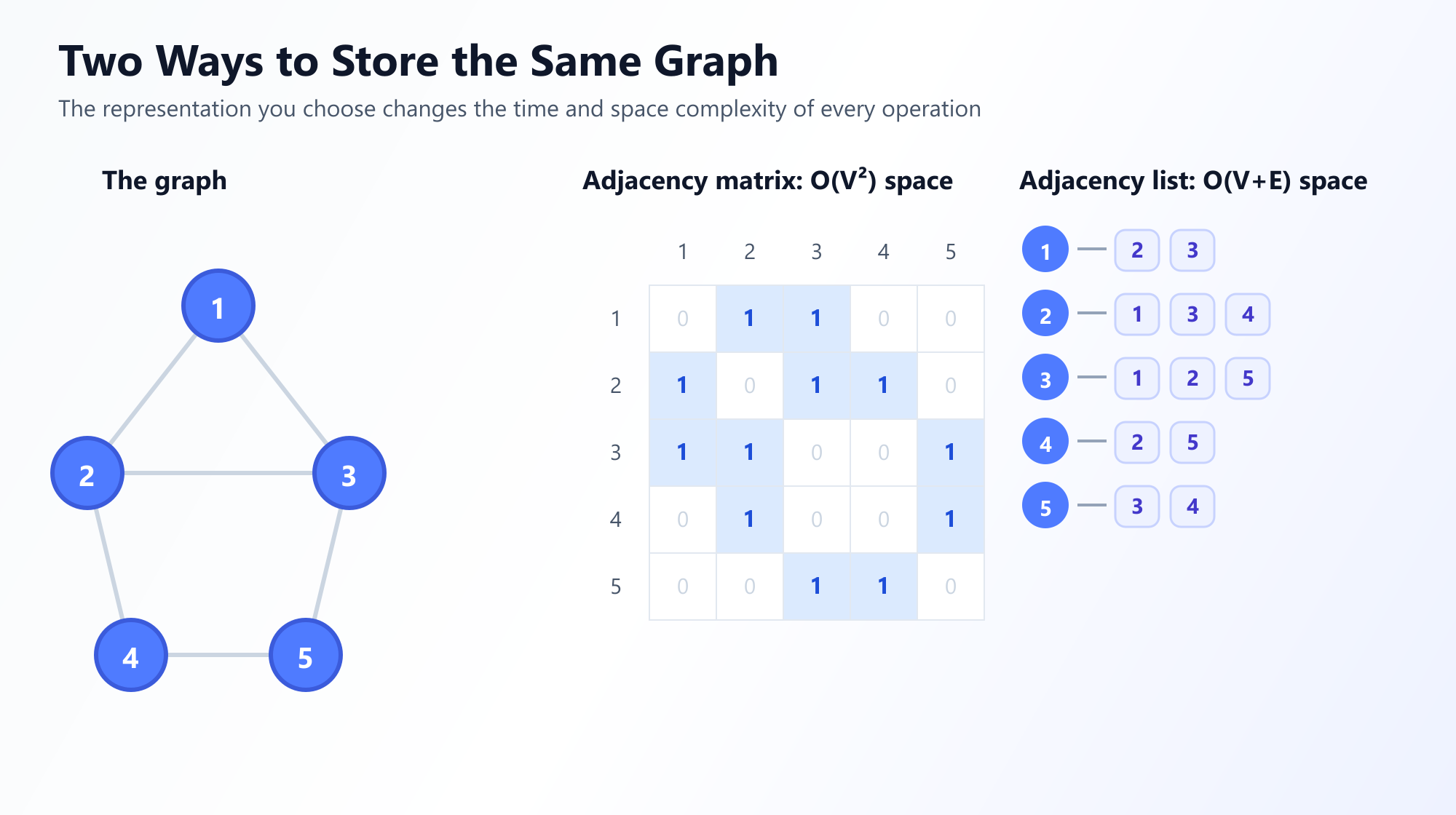
Conclusion: Unless dealing with a dense graph where you need constant-time edge lookups, the Adjacency List is the standard. For the rest of this article, assume all complexities are based on an Adjacency List representation unless stated otherwise.
3. Graph Traversal Algorithms
Traversals form the backbone of almost all complex graph logic. They are used to visit every node and edge in a graph systematically.
Breadth-First Search (BFS)
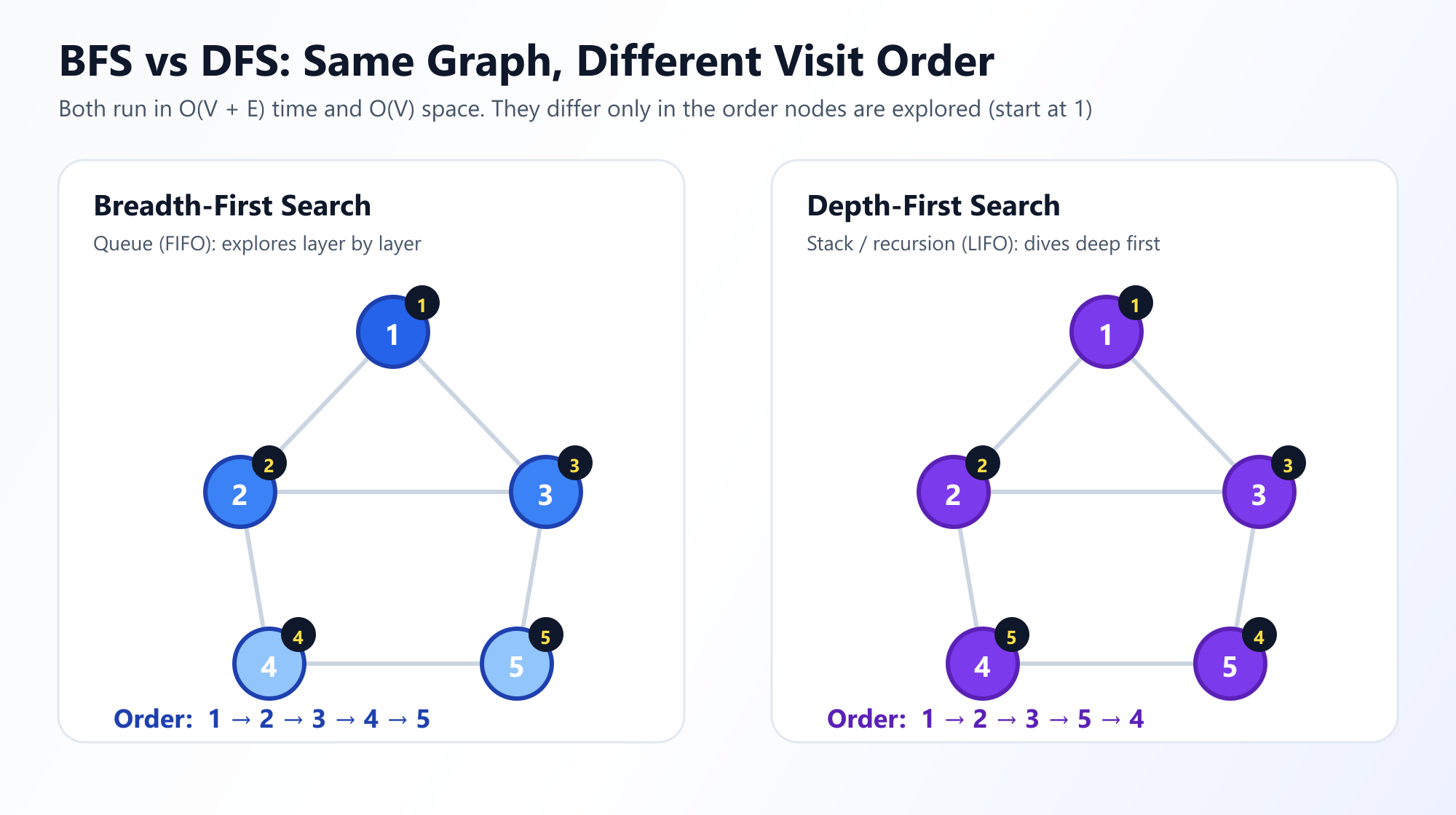
BFS explores a graph layer by layer, starting from a source node and exploring all its immediate neighbors before moving to the next level. It uses a Queue (FIFO) data structure.
- Time Complexity:
O(V + E). Each vertex is enqueued and dequeued exactly onceO(V), and every edge is examined once for directed graphs or twice for undirected graphsO(E). Thus, the total operations scale linearly with the size of the graph. - Space Complexity:
O(V). In the worst case (like a star graph), the queue will hold all vertices except the root at the same time. The visited array also requiresO(V)space. - Use Cases: Shortest path in unweighted graphs, peer-to-peer networks, web crawlers.
Depth-First Search (DFS)
DFS goes as deep as possible along a branch before backtracking. It relies heavily on recursion (Call Stack) or an explicit Stack (LIFO).
- Time Complexity:
O(V + E). Similar to BFS, every vertex is visited once, and every edge is examined once (or twice). The asymptotic time is identical to BFS. - Space Complexity:
O(V). The maximum depth of the recursion stack can reachVif the graph is a single long path (e.g., a linked list structure). - Use Cases: Topological sorting, cycle detection, solving mazes, pathfinding in heavily constrained environments.
4. Shortest Path Algorithms
Shortest path algorithms are the most frequently used graph algorithms in the real world, heavily applied in mapping services, network routing protocols, and AI navigation.
Dijkstra’s Algorithm
Dijkstra computes the shortest path from a single source node to all other nodes in a graph with non-negative edge weights. It uses a Greedy approach and a Priority Queue.
The complexity of Dijkstra is entirely dependent on the data structure used to implement the Priority Queue.
- With a basic Array/List: Time:
O(V²). Extracting the minimum takesO(V), doneVtimes. Updating neighbors takesO(E)total. Best for dense graphs whereE ≈ V². - With a Binary Min-Heap: Time:
O((V + E) log V). Extracting the minimum takesO(log V), doneVtimes. Updating a key (decrease-key) takesO(log V), doneEtimes. Best for typical, sparse graphs. - With a Fibonacci Heap: Time:
O(E + V log V). A Fibonacci Heap allowsdecrease-keyoperations to run inO(1)amortized time, leaving only theVextractions takingO(log V). This is the theoretical optimal complexity for Dijkstra. - Space Complexity:
O(V). To store distances, predecessors, and the Priority Queue.
Bellman-Ford Algorithm
Unlike Dijkstra, Bellman-Ford can handle graphs with negative edge weights and detect negative weight cycles. It does this by repeatedly "relaxing" all edges.
- Time Complexity:
O(V × E). The algorithm loopsV-1times, and in each loop, it iterates over allEedges. This is significantly slower than Dijkstra, so it should only be used when negative weights are present. - Space Complexity:
O(V). Requires an array to store the current shortest distances from the source.
Floyd-Warshall Algorithm
Floyd-Warshall is an All-Pairs Shortest Path algorithm. It finds the shortest paths between every pair of vertices in a weighted graph (even with negative weights, provided there are no negative cycles). It uses Dynamic Programming.
- Time Complexity:
O(V³). It features three nested loops, each iterating from 1 toV, updating the matrix of shortest paths. Because of this cubic complexity, it is only viable for small graphs (typicallyV < 500). - Space Complexity:
O(V²). It maintains a 2D distance matrix.
A* Search Algorithm
A* is a targeted search algorithm used extensively in video game pathfinding (like NPC movement) and GPS routing. It is essentially Dijkstra's algorithm augmented with a Heuristic function h(n) that estimates the distance to the goal, steering the search direction.
- Time Complexity: Worst-case
O(b^d), wherebis the branching factor (average number of edges per node) anddis the depth of the optimal solution. In the best case (perfect heuristic), it isO(d). If the heuristic is 0, A* degrades to Dijkstra'sO((V + E) log V). - Space Complexity:
O(b^d)in the worst case, as it must keep all generated nodes in memory (in the OPEN and CLOSED lists). The massive space requirement is usually the bottleneck for A*, leading to variants like Iterative Deepening A* (IDA*).
5. Minimum Spanning Tree Algorithms
A Minimum Spanning Tree (MST) is a subset of the edges of a connected, edge-weighted undirected graph that connects all the vertices together, without any cycles, and with the minimum possible total edge weight. MSTs are crucial in network design, such as laying cables, electrical grids, and piping systems.
Kruskal’s Algorithm
Kruskal's takes a global greedy approach: sort all edges by weight, and continually pick the smallest edge that does not form a cycle. It relies on a Disjoint-Set (Union-Find) data structure to detect cycles.
- Time Complexity:
O(E log E)orO(E log V). Sorting the edges dominates the time, takingO(E log E). SinceE ≤ V²,log E ≤ 2 log V, meaningO(E log E)is asymptotically equivalent toO(E log V). The Union-Find operations take practicallyO(1)time, specificallyO(α(V))whereαis the inverse Ackermann function. - Space Complexity:
O(V + E)to store the graph and the Union-Find structure.
Prim’s Algorithm
Prim's algorithm builds the MST piece by piece, starting from an arbitrary node and greedily adding the cheapest edge that connects the growing tree to a new vertex outside the tree.
- Time Complexity: Prim's complexity depends on the Priority Queue used, making its analysis identical to Dijkstra's algorithm. With a Binary Heap, it runs in
O((V + E) log V). With a Fibonacci Heap, it runs inO(E + V log V). - Space Complexity:
O(V)for the Priority Queue and tracking arrays.
Kruskal vs. Prim: Generally, Kruskal's algorithm is preferred for sparse graphs (because sorting E elements is fast), while Prim's algorithm using a Fibonacci heap is mathematically superior for dense graphs.
6. Connectivity and Topological Sorting
Analyzing the structure and dependencies within a graph requires specialized algorithms. These operate heavily on Directed Acyclic Graphs (DAGs) and complex directed networks.
Topological Sort (Kahn's Algorithm & DFS-based)
Topological sorting is a linear ordering of its vertices such that for every directed edge uv from vertex u to vertex v, u comes before v. It is primarily used for task scheduling, resolving package dependencies, and build systems.
- Time Complexity:
O(V + E). Both Kahn's Algorithm (which uses in-degree arrays and a queue) and the DFS-based approach visit every node and edge exactly once. - Space Complexity:
O(V)for the queue/stack and arrays keeping track of visited status and in-degrees.
Strongly Connected Components (Tarjan's and Kosaraju's)
A Strongly Connected Component (SCC) in a directed graph is a maximal subset of vertices where every vertex is reachable from every other vertex in that subset. Identifying SCCs is vital in recommendation engines, circuit design, and ecosystem modeling.
- Kosaraju's Algorithm: Involves two passes of DFS. First pass on the original graph, second pass on the transposed (reversed edges) graph. Time:
O(V + E). Space:O(V). - Tarjan's Algorithm: Requires only a single pass of DFS, using an array to track "low link" values to identify component roots. Time:
O(V + E). Space:O(V). Tarjan's is generally preferred in practice because performing a single DFS pass has better cache locality and less overhead than reversing the entire graph.
Deep dive: the full guide to strongly connected components traces Tarjan's and Kosaraju's algorithms step by step, or run them in the Tarjan visualizer.
7. Network Flow Algorithms
Network flow algorithms determine the maximum amount of flow that can pass from a source to a sink through a network of pipes with defined capacities. Applications include traffic routing, fluid dynamics, bipartite matching, and internet packet routing.
Ford-Fulkerson Method
The original method finds augmenting paths from source to sink using DFS and pushes flow until no paths remain.
- Time Complexity:
O(E × F), whereFis the maximum flow of the network. The danger here is that if the capacities are very large or irrational numbers, Ford-Fulkerson can take extremely long or never terminate. This is pseudo-polynomial time. - Space Complexity:
O(V)to maintain the visited array during DFS.
Edmonds-Karp Algorithm
An implementation of Ford-Fulkerson that uses BFS instead of DFS to find the shortest augmenting path (in terms of number of edges). This guarantees termination.
- Time Complexity:
O(V × E²). It can be proven that the maximum number of augmentations is bounded byO(V × E), and each BFS takesO(E). This is strongly polynomial and independent of the maximum flowF. - Space Complexity:
O(V + E)for the BFS queue and storing the residual graph.
Dinic's Algorithm
Dinic's drastically optimizes flow calculation by building "Level Graphs" using BFS and then pushing multiple flows simultaneously using blocking flows via DFS.
- Time Complexity:
O(V² × E). In networks with unit capacities (like bipartite matching), the complexity drops remarkably toO(E × √V). It is the gold standard for competitive programming and practical network flow execution. - Space Complexity:
O(V + E).
8. NP-Hard Graph Problems
Some of the most famous problems in graph theory do not have any known polynomial-time O(N^k) solutions. These are classified as NP-Hard, meaning their complexity grows factorially or exponentially.
The Traveling Salesperson Problem (TSP)
Finding the shortest possible route that visits every node exactly once and returns to the origin.
- Brute Force:
O(V!)(Factorial time). Evaluating all permutations. Unusable forV > 15. - Dynamic Programming (Held-Karp):
O(V² 2^V). Significantly better than factorial, but still exponential. Space complexity is heavy:O(V 2^V). Unusable forV > 30.
Graph Coloring Problem
Assigning a color to each vertex such that no two adjacent vertices share the same color, using the minimum number of colors.
- Time Complexity: Checking if a graph can be colored with
kcolors is NP-Complete. Exact algorithms run inO(2^V)or worse. Modern solutions rely on heuristics, greedy approaches (like Welsh-Powell), or approximation algorithms rather than seeking perfect solutions.
9. The Ultimate Complexity Cheat Sheet
Bookmark this page. Below is a comprehensive table summarizing the time and space complexity of every algorithm discussed. (Assuming Adjacency List representation and Binary Heaps where applicable).
| Algorithm | Category | Time Complexity (Worst) | Space Complexity |
|---|---|---|---|
| Breadth-First Search (BFS) | Traversal | O(V + E) |
O(V) |
| Depth-First Search (DFS) | Traversal | O(V + E) |
O(V) |
| Dijkstra's (Binary Heap) | Shortest Path | O((V + E) log V) |
O(V) |
| Dijkstra's (Fibonacci Heap) | Shortest Path | O(E + V log V) |
O(V) |
| Bellman-Ford | Shortest Path (Negative) | O(V × E) |
O(V) |
| Floyd-Warshall | All-Pairs Shortest Path | O(V³) |
O(V²) |
| A* Search | Heuristic Search | O(b^d) |
O(b^d) |
| Kruskal's Algorithm | Minimum Spanning Tree | O(E log E) |
O(V + E) |
| Prim's Algorithm | Minimum Spanning Tree | O((V + E) log V) |
O(V) |
| Topological Sort | DAG Processing | O(V + E) |
O(V) |
| Tarjan's / Kosaraju's | Strongly Connected Comps. | O(V + E) |
O(V) |
| Ford-Fulkerson | Network Flow | O(E × F) |
O(V) |
| Edmonds-Karp | Network Flow | O(V × E²) |
O(V + E) |
| Dinic's Algorithm | Network Flow | O(V² × E) |
O(V + E) |
| Traveling Salesperson (DP) | NP-Hard | O(V² 2^V) |
O(V 2^V) |
Frequently Asked Questions
Why is graph representation important for complexity?
The choice between an adjacency matrix and an adjacency list drastically changes the time and space complexity of algorithms. An adjacency list generally performs better for sparse graphs, while an adjacency matrix is better for dense graphs and quick edge lookups.
What is the time complexity of Dijkstra's algorithm?
Using a binary heap, Dijkstra's algorithm runs in O((V + E) log V) time. With an optimized Fibonacci heap, the time complexity drops to O(E + V log V), making it much faster for dense graphs.
What is the difference in complexity between BFS and DFS?
Both Breadth-First Search (BFS) and Depth-First Search (DFS) share the same worst-case time complexity of O(V + E) and space complexity of O(V), assuming an adjacency list representation. The difference lies in their traversal patterns and structural applications, rather than their asymptotic complexity.
Why use Bellman-Ford if it's slower than Dijkstra's?
Dijkstra's algorithm cannot handle graphs with negative edge weights; it will produce incorrect results. Bellman-Ford runs in O(V × E) but can safely route paths through negative edges and detect negative weight cycles, making it essential for certain financial or specialized routing models.