
Table of Contents
- 1. The definition never said finite
- 2. How big: countable, uncountable, locally finite
- 3. What finiteness was silently buying you
- 4. A one-line counterexample to the handshaking corollary
- 5. König's infinity lemma: the first bridge
- 6. De Bruijn and Erdős: colouring transfers
- 7. Rays, double rays and ends
- 8. Spanning trees and the axiom of choice
- 9. The Rado graph: one graph to rule them all
- 10. When infinite is easier
- 11. Infinite graphs in computing
- 12. Common mistakes
- 13. Glossary
- 14. Frequently asked questions
- 15. References
1. The definition never said finite
Go back to the definition in the guide to vertices and edges and read it for what it actually says:
G = (V, E) with E ⊆ [V]²A set of vertices and a set of 2-element subsets of it. Nothing there mentions size. V may be the four landmasses of Königsberg, the integers, the reals, or the set of all finite binary strings, and the definition does not flinch. An infinite graph is simply a graph whose vertex set is infinite, and the whole subject of this article is what quietly stops working when it is.
This is not a modern refinement. The first book ever written on graph theory is Dénes König's Theorie der endlichen und unendlichen Graphen of 1936, whose title translates as Theory of Finite and Infinite Graphs. Infinite graphs were in the subject from its first textbook, and Diestel's Graph Theory still devotes a full chapter to them.
The important move is to notice that "finite" is a hypothesis you have been using without seeing it. Most textbook statements are of the form "let G be a finite graph", and most of the standard proof techniques quietly need it:
- Induction on the number of vertices needs a number of vertices to induct on.
- Extremal arguments ("take the vertex of maximum degree", "take the longest path") need the maximum or longest to exist.
- Counting arguments need the counts to be finite numbers rather than cardinals.
- Termination of an algorithm needs the search to run out of graph.
Remove finiteness and each of those has to be replaced by something else. What replaces them, in almost every case, is compactness: the idea that a statement about an infinite object can sometimes be assembled from statements about all of its finite pieces. Sections 5 and 6 are the two classical theorems that do exactly that.
2. How big: countable, uncountable, locally finite
"Infinite" is not one size, and three separate measurements matter. Conflating them is the first source of confusion.
| Measurement | What it asks | Why it matters |
|---|---|---|
| Cardinality of V | Countable (ℵ0) or uncountable? | Countable graphs can be enumerated v1, v2, …, which is what most constructions rely on |
| Cardinality of E | How many edges? | A countable graph has at most countably many edges, so |E| ≤ ℵ0 follows from |V| = ℵ0 |
| Local finiteness | Is every degree finite? | The single most important dividing line: it is the hypothesis of König's lemma |
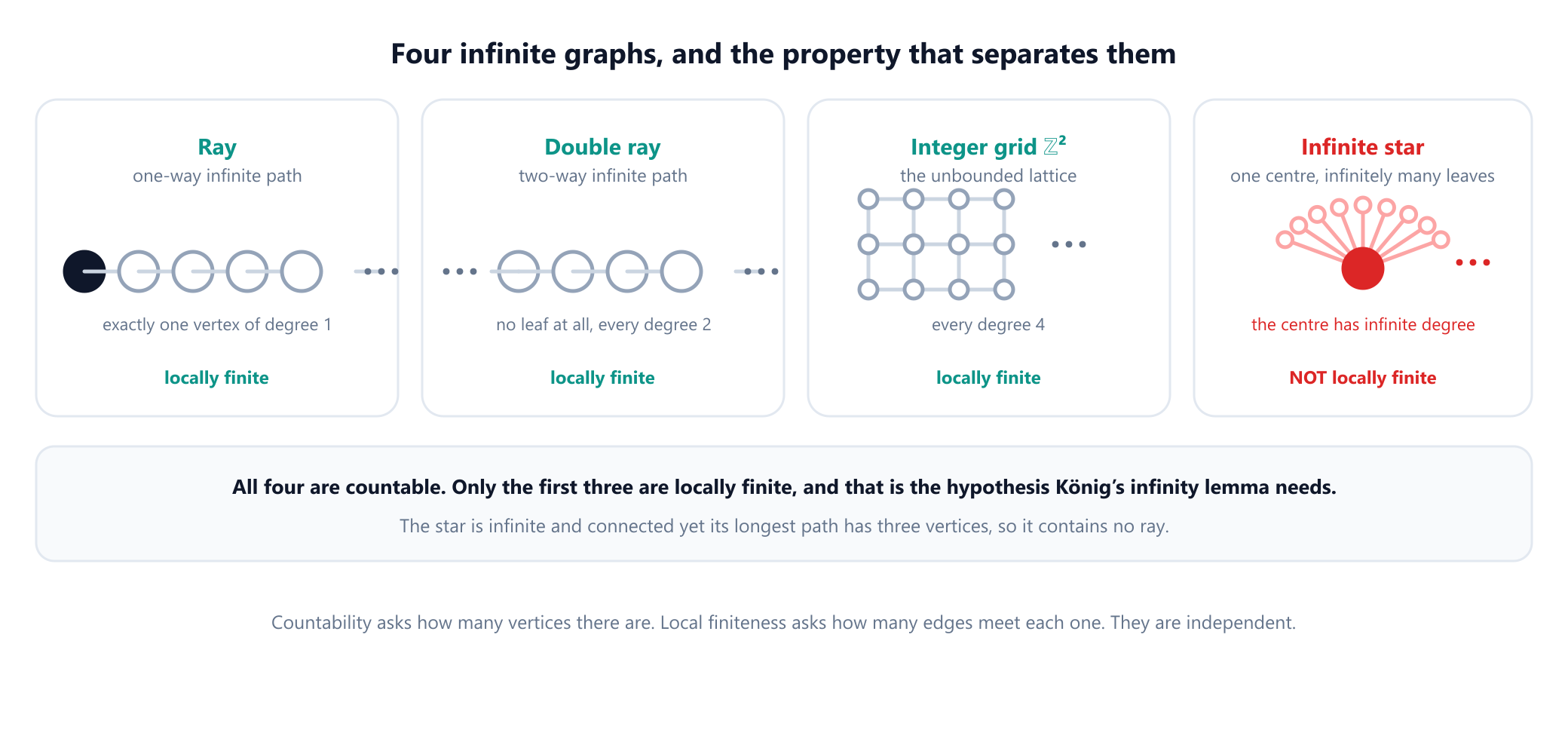
A graph is locally finite when every vertex has finite degree. It is a genuinely independent condition from countability, and the two combine in all four ways:
- The double ray, an infinite path running in both directions, is countable and locally finite: every degree is 2.
- The infinite square grid on
ℤ²is countable and locally finite: every degree is 4. This is the graph a spreadsheet, a cellular automaton or a tiled game world actually lives on. - The infinite star, one centre joined to countably many leaves, is countable but not locally finite: the centre has infinite degree.
- The complete graph on an uncountable vertex set is uncountable and not locally finite.
- An uncountable collection of disjoint double rays is uncountable yet locally finite: there are uncountably many vertices, and every one of them still has degree 2. This is the fourth combination, and it shows that neither condition implies anything about the other.
One consequence is worth stating because it trips people up: a locally finite graph can still be infinite, and an infinite graph can have every degree small. Local finiteness bounds each vertex individually; it says nothing about the size of the graph.
3. What finiteness was silently buying you
Here is the honest inventory. These are standard results and standard techniques, and each fails on infinite graphs for a specific reason.
| Finite fact | Infinite status | Counterexample or reason |
|---|---|---|
| A tree with at least 2 vertices has at least 2 leaves | Fails | The ray has exactly one leaf; the double ray has none |
| Some vertex has maximum degree | Fails | Degrees 1, 2, 3, … with no vertex attaining a maximum |
| The number of odd-degree vertices is even | Fails | The ray has exactly one, see section 4 |
| Induction on |V| | Unavailable | There is no number of vertices to induct on; transfinite induction needs a well-ordering |
| BFS terminates | Fails | It enumerates forever; it is a semi-decision procedure, see section 11 |
| A connected graph has a spanning tree | Holds, but needs choice | See section 8 |
| k-colourability | Transfers from finite subgraphs | De Bruijn and Erdős, section 6 |
| An infinite connected graph contains a ray | Holds if locally finite | König's infinity lemma, section 5; false without local finiteness |
| Ramsey-type results | Often easier | The infinite version has a clean proof and no bounds to optimise, section 10 |
Two rows deserve immediate comment because they are the ones people find most surprising.
"Some vertex has maximum degree" fails, and it fails for the most mundane reason in analysis: an infinite set of natural numbers need not contain a largest element. Build a graph whose vertices have degrees 1, 2, 3 and so on without bound, and the quantity Δ(G) is simply not defined. Every extremal argument that begins "let v be a vertex of maximum degree" has therefore quietly assumed finiteness, or at least a bound.
The infinite star breaks König's lemma, which is why local finiteness appears in its statement. The star is infinite and connected, yet its longest path has length 2: leaf, centre, leaf. There is no ray anywhere in it. One vertex of infinite degree is enough to destroy the conclusion, which tells you the hypothesis is doing real work rather than being technical hygiene.
4. A one-line counterexample to the handshaking corollary
The handshaking lemma is the oldest theorem in the subject, and its corollary is the one everybody remembers: the number of vertices of odd degree is even. On infinite graphs it is false, and the counterexample takes one line to draw.
Take the ray: vertices v0, v1, v2, … with an edge between consecutive ones.
v0 ── v1 ── v2 ── v3 ── v4 ── ⋯

deg(v0) = 1        odd
deg(vi) = 2        even, for every i ≥ 1

odd-degree vertices: exactly one.  The finite corollary says the count must be even.
It is worth being precise about what survives, because the answer is more interesting than a flat "it fails".
The equation ∑ deg(v) = 2|E| does not become false; it becomes vacuous. Both sides are cardinal numbers, and for an infinite cardinal κ we have 2κ = κ, so the identity holds trivially and tells you nothing. What actually breaks is the parity argument built on it. That argument splits a finite sum into odd and even parts and concludes that the odd part has an even number of terms, and it is the finiteness of the sum, not the equation, that makes the step legal.
The lesson generalises: when a finite theorem fails on infinite graphs, it is usually not the statement that breaks but the proof technique, and the technique is usually counting.
5. König's infinity lemma: the first bridge
If finiteness is what most proofs rely on, the interesting question is what can replace it. The first and most useful answer is a lemma König published in 1927, nine years before his textbook.
König's infinity lemma. Every infinite, connected, locally finite graph contains a ray, that is, an infinite path v0, v1, v2, … with no repeated vertex.
The proof is a pigeonhole argument run infinitely often, and it is worth seeing because the shape recurs throughout infinite combinatorics.
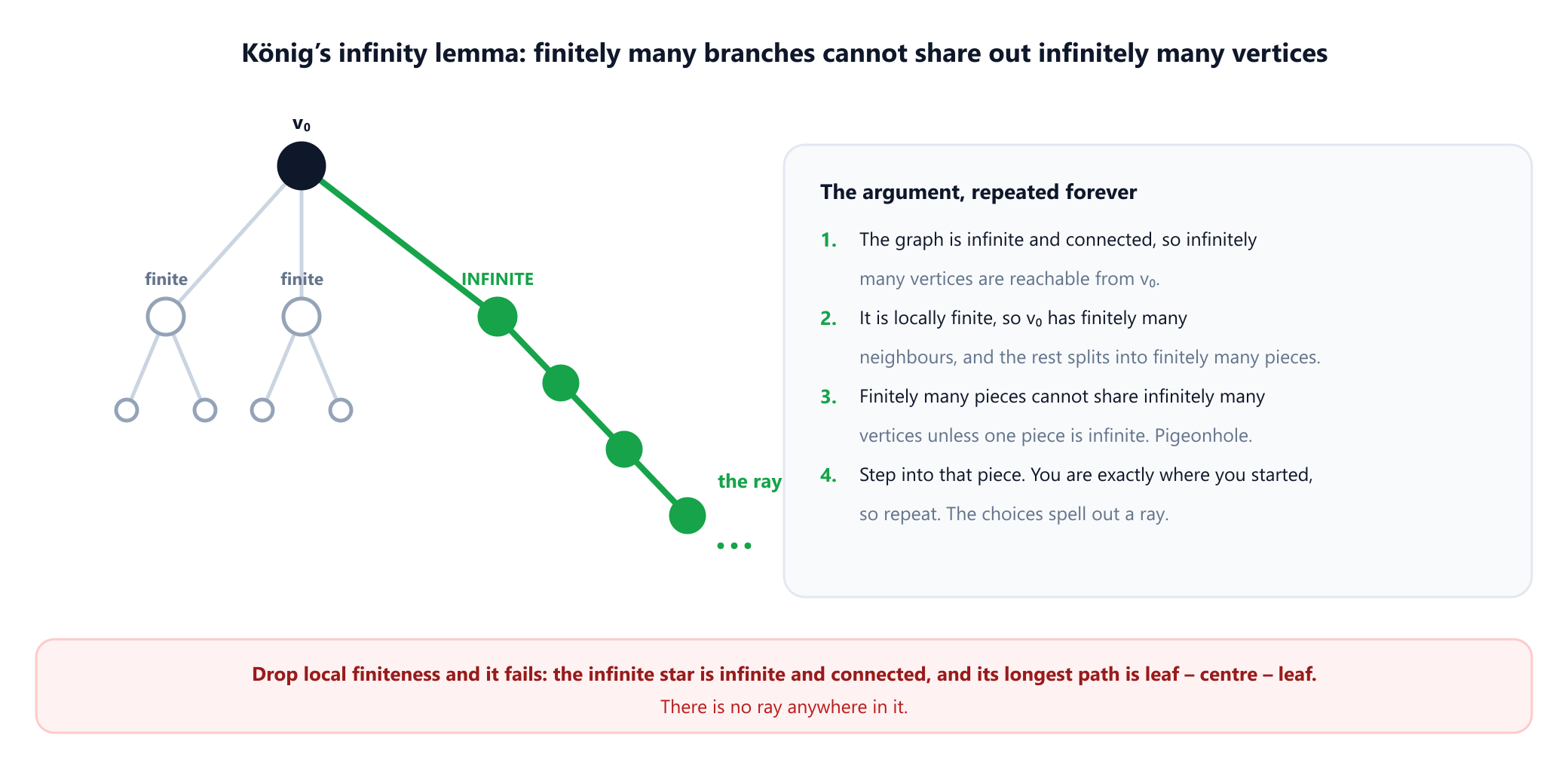
Start at any vertex v0. The graph is infinite and connected, so infinitely many vertices are reachable from it. The graph is locally finite, so v0 has only finitely many neighbours. Deleting v0 splits those infinitely many remaining vertices among finitely many pieces, so by the pigeonhole principle at least one piece is infinite. Step into it, and you are in exactly the situation you started in. Repeating forever produces v0, v1, v2, …, and because each step moves into a region you have not yet visited, no vertex repeats.
Both hypotheses are doing work, and dropping either one kills the conclusion:
- Drop local finiteness and the infinite star is a counterexample: infinite, connected, and its longest path has 3 vertices.
- Drop infiniteness and there is nothing to prove.
The lemma reaches well beyond graph theory. In its tree form, "an infinite finitely branching tree has an infinite branch", it is the combinatorial core of compactness arguments in logic, and it is what lets you conclude that a computation with infinitely many finite states must have an infinite run. It is the same idea that underlies the compactness theorem for propositional logic, which is where the next section comes from.
6. De Bruijn and Erdős: colouring transfers
The second great bridge takes a property that is checkable on finite pieces and lifts it to the whole infinite graph.
De Bruijn–Erdős theorem (1951). For a finitek, an infinite graph isk-colourable if and only if every one of its finite subgraphs isk-colourable.
The "only if" direction is trivial: a colouring of the whole graph restricts to every subgraph. The content is the other direction, and it is genuinely surprising. It says that colourability, which is a global constraint over infinitely many vertices simultaneously, is entirely determined by what happens on finite windows. Nothing new can go wrong "at infinity".
Two qualifications that matter, and that popular accounts usually skip:
- The number of colours must be finite. The theorem is about a fixed finite
k. It does not say that a graph whose finite subgraphs are all colourable with finitely many colours is finitely colourable. - It needs a choice principle. The standard proofs go through Tychonoff's theorem for compact Hausdorff spaces, Zorn's lemma, or the ultrafilter lemma. In Zermelo-Fraenkel set theory without any choice, the theorem is not provable. De Bruijn and Erdős worked with the axiom of choice available, as almost everyone does.
The practical reading for anyone modelling an unbounded system: if your constraint can be expressed as a colouring with a fixed finite palette, you can verify it on finite fragments and conclude it for the whole. That is exactly the licence a compactness argument gives you, and it is why finite model checking can sometimes say something about unbounded runs.
7. Rays, double rays and ends
Finite graph theory has no vocabulary for "what the graph looks like far away", because a finite graph has no far away. Infinite graph theory needs one, and the standard construction is due to Halin.
- A ray is a one-way infinite path
v0, v1, v2, …. König's lemma says every infinite connected locally finite graph has one. - A double ray is a two-way infinite path, indexed by all of
ℤ. It is an infinite tree with no leaves at all, which is exactly what no finite tree can be. - An end is an equivalence class of rays, where two rays count as equivalent when no finite set of vertices separates them. Ends are the formal answer to "how many distinct directions does this graph run off in".
The notion is easier to feel through examples than to define:
| Graph | Ends | Reading |
|---|---|---|
| The ray | 1 | It runs off in a single direction |
| The double ray | 2 | Two directions; cutting any finite piece leaves two infinite halves |
The infinite grid ℤ² | 1 | Removing any finite patch still leaves one connected infinite region, so all rays are equivalent |
| The infinite binary tree | Uncountably many | One per infinite branch, and the branches correspond to infinite binary strings |
The grid entry is the instructive one. Intuitively a plane runs off in every direction, so you might expect many ends, but the definition asks whether rays can be separated by removing finitely many vertices, and in a grid they cannot: go far enough out and you can always walk around any finite hole. One end is the right answer, and it is the definition, not the picture, that decides.
8. Spanning trees and the axiom of choice
Every finite connected graph has a spanning tree, and the proof is a two-line greedy argument: keep deleting an edge that lies on a cycle until none is left. It terminates because there are finitely many edges.
The infinite statement is still true, but it is true for a different and much deeper reason:
Every connected graph has a spanning tree. For infinite graphs this requires the axiom of choice, and the statement is in fact equivalent to it.
The usual proof applies Zorn's lemma to the family of acyclic subgraphs ordered by inclusion, which is a choice principle in disguise. That the implication runs both ways, so that "every connected graph has a spanning tree" is not merely a consequence of choice but as strong as it, is a genuinely striking result: an innocuous-looking statement about graphs turns out to be one of the many equivalent forms of a set-theoretic axiom.
The practical significance is small and the conceptual significance is large. No algorithm you write will be affected, because the graphs a program touches are finite or at least computably presented. But it marks precisely where infinite graph theory stops being combinatorics and starts being set theory, and it explains why textbooks on infinite graphs are careful to say which choice principles they assume.
The same pattern recurs elsewhere. Several statements that are routine for finite graphs turn out, in their infinite versions, to depend on choice or to be independent of the base axioms, which is why De Bruijn–Erdős also carries a choice hypothesis.
9. The Rado graph: one graph to rule them all
Infinite graphs are not merely finite graphs with more of everything. Some of them behave in ways that have no finite analogue at all, and the cleanest example is the Rado graph.
Say a countable graph has the extension property if, for every pair of disjoint finite sets of vertices U and W, there exists a vertex joined to every vertex in U and to none in W. Then:
Uniqueness. Any two countable graphs with the extension property are isomorphic. There is, up to isomorphism, exactly one such graph: the Rado graph, also called the random graph R.
And the reason it is called the random graph is the second half of the story. Erdős and Rényi showed that if you build a countably infinite graph by deciding each possible edge independently with probability 1/2, the result satisfies the extension property with probability 1. So:
Toss a fair coin for every pair of vertices in a countably infinite set.
With probability 1 the graph you get is the Rado graph.
Do it again, differently. You get the Rado graph again, up to isomorphism.
There is essentially one countably infinite random graph. Nothing remotely like this happens for finite graphs, where random graphs on n vertices are wildly various and the interesting questions are all about which properties hold with high probability. The Rado graph also contains every finite graph and every countable graph as an induced subgraph, which makes it universal for countable graphs.
The point for a working reader is not the construction itself but the warning it carries: intuitions calibrated on finite graphs are not just quantitatively but qualitatively wrong at infinity. "Random" stops meaning "varied" and starts meaning "canonical".
10. When infinite is easier
It would be reasonable to assume infinite graphs are uniformly harder. Sometimes the opposite is true, and Ramsey theory is the standard illustration.
| Finite Ramsey | Infinite Ramsey | |
|---|---|---|
| Statement | For every k there is an N such that any 2-colouring of the edges of KN has a monochromatic Kk | Any 2-colouring of the edges of the complete graph on a countably infinite vertex set has an infinite monochromatic complete subgraph |
| Proof | Harder, and the bounds are the subject of a large literature | A short pigeonhole argument |
| Open problems | Even R(5,5) is unknown | The statement is clean and settled |
Ramsey proved both in his 1930 paper. The infinite version is easier precisely because it does not ask for a bound: you never have to say how far out the monochromatic structure appears, only that it appears. Extracting the finite version from the infinite one is possible, by a compactness argument of the same family as König's lemma, but the bounds it yields are terrible, which is why finite Ramsey theory is a separate and much harder subject.
The general moral: infinite statements are often cleaner because they are not quantitative. Whenever a finite theorem is hard because of its bounds, its infinite analogue may be much simpler and may still tell you something useful.
11. Infinite graphs in computing
Infinite graphs are not a purely mathematical indulgence. They appear constantly in computer science, usually implicitly, and always in the same disguised form: a graph you never build.
- State spaces. The configuration graph of a Turing machine, a program with unbounded integers, or a protocol with unbounded queues is infinite. Model checking such a system is exactly the study of an infinite graph presented by a finite description.
- Lattices and grids. Pathfinding on an unbounded tile map, cellular automata and image lattices all live on
ℤ², an infinite locally finite graph. - Game trees. The full tree of a game with no move limit is infinite; search algorithms explore a finite prefix of it.
- Cayley graphs. An infinite group with a chosen generating set gives an infinite vertex-transitive graph, and geometric group theory studies groups precisely through these graphs and their ends.
- Recursively defined structures. The graph of all finite strings under "append one character" is an infinite tree, and it is the object König's lemma is usually applied to in computability.
The engineering consequence is a single sharp distinction:
On an infinite locally finite graph, search becomes semi-decidable. A breadth first search fromswill find a path totif one exists, and will run forever if none does. Local finiteness is what makes each level finite, so that the search reaches every distance in finite time. It can confirm reachability but never refute it.
That asymmetry is why BFS rather than DFS is the right choice on an infinite graph: BFS explores in order of distance and will reach any reachable vertex in finite time, whereas DFS can descend a single infinite branch and never come back. It is the same reason iterative deepening exists. To get termination you need something extra, such as local finiteness plus a bound, a monotone measure that decreases, or a finite abstraction of the state space.
12. Common mistakes
- Assuming a maximum or minimum exists. "Take the vertex of maximum degree" and "take the longest path" both presuppose finiteness or an explicit bound. On an infinite graph they may denote nothing at all.
- Using the odd-degree corollary. The ray has exactly one odd-degree vertex, as section 4 shows.
- Inducting on the number of vertices. There is no such number. Transfinite induction is available but needs a well-ordering, which is another appeal to choice.
- Forgetting local finiteness in König's lemma. The infinite star is infinite, connected, and contains no ray. The hypothesis is not decoration.
- Expecting termination. Search on an infinite graph is semi-decidable, so a "no path" answer never arrives. Bound the search explicitly, or work with a finite abstraction.
- Running DFS on an infinite graph. A single infinite branch swallows it. Use BFS or iterative deepening.
- Applying finite counting results. Anything proved by counting vertices, edges or incidences needs re-examination; anything proved by compactness usually survives.
- Treating "infinite" as one thing. Countable versus uncountable and locally finite versus not are independent, and almost every theorem depends on which combination you have.
13. Glossary
| Term | Meaning |
|---|---|
| Infinite graph | A graph whose vertex set is infinite; the definition G = (V, E) is unchanged |
| Countable graph | |V| = ℵ0, so the vertices can be listed v1, v2, … |
| Locally finite | Every vertex has finite degree; independent of how large the graph is |
| Ray | A one-way infinite path with no repeated vertex |
| Double ray | A two-way infinite path, indexed by the integers |
| End | An equivalence class of rays, where two rays are equivalent if no finite vertex set separates them |
| König's infinity lemma | Every infinite connected locally finite graph contains a ray |
| De Bruijn–Erdős theorem | For finite k, k-colourability of an infinite graph follows from k-colourability of all its finite subgraphs |
| Rado graph | The unique countable graph with the extension property; the countable random graph |
| Extension property | For disjoint finite U and W there is a vertex joined to all of U and none of W |
| Compactness argument | Deducing a property of an infinite graph from the same property on all its finite subgraphs |
| Semi-decidable | A yes-answer arrives in finite time; a no-answer may never arrive |
14. Frequently asked questions
What is an infinite graph?
A graph whose vertex set is infinite. The definition G = (V, E) with E a set of 2-element subsets of V says nothing about size, so no change to the definition is needed. What changes is which theorems and proof techniques still apply: induction on the number of vertices, extremal arguments that pick a maximum, and counting arguments all rely on finiteness, while compactness arguments such as König's infinity lemma survive.
What does locally finite mean, and why does it matter so much?
A graph is locally finite when every vertex has finite degree, which is independent of whether the graph itself is finite. It matters because it is the hypothesis of König's infinity lemma: every infinite, connected, locally finite graph contains a ray. Drop it and the conclusion fails immediately, since the infinite star is infinite and connected yet its longest path has only three vertices. Most infinite graphs that arise in computing, such as the integer grid and state spaces with finitely many moves per state, are locally finite.
Does the handshaking lemma work on infinite graphs?
Not usefully. The equation itself becomes vacuous: both sides are infinite cardinals, and doubling an infinite cardinal changes nothing, so it holds trivially and carries no information. The corollary everyone actually uses, that the number of odd-degree vertices is even, is simply false. The one-way infinite path has exactly one vertex of degree 1 and all others of degree 2, so it has exactly one odd-degree vertex.
Can BFS or DFS run on an infinite graph?
BFS can, in a limited sense: on a locally finite graph it reaches every vertex at distance d in finite time, so it will find a path to the target if one exists. It will not terminate if no path exists, which makes reachability semi-decidable rather than decidable. DFS is worse, because it can descend a single infinite branch and never return, so it may miss a target that lies one step off the start. Use BFS or iterative deepening, and bound the search explicitly if you need an answer either way.
Is there really only one countably infinite random graph?
Up to isomorphism, yes. Build a countably infinite graph by deciding each possible edge independently with probability one half, and with probability 1 the result has the extension property. Any two countable graphs with that property are isomorphic, so almost every such random construction produces the same graph, the Rado graph. It is also universal: every finite and every countable graph appears in it as an induced subgraph. Nothing comparable happens for finite random graphs.
Do infinite graphs matter in practice, or are they purely theoretical?
They appear constantly, always as a graph you never build. The configuration space of a program with unbounded integers, the tile map of an unbounded game world, a game tree with no move limit, and the tree of all finite strings are all infinite graphs given by finite descriptions. Model checking, termination analysis and search over unbounded state spaces are, formally, infinite graph problems. The practical consequence is that search becomes semi-decidable, so algorithms need an explicit bound or a finite abstraction to guarantee an answer.
15. References
The definitions, theorems and attributions above come from these sources, listed in chronological order.
- König, D. (1927). "Über eine Schlussweise aus dem Endlichen ins Unendliche." Acta Litterarum ac Scientiarum Regiae Universitatis Hungaricae Francisco-Josephinae, Sectio Scientiarum Mathematicarum (Szeged) 3, 121 to 130. The infinity lemma.
- Ramsey, F. P. (1930). "On a Problem of Formal Logic." Proceedings of the London Mathematical Society s2-30, 264 to 286. Contains both the finite and the infinite Ramsey theorems.
- König, D. (1936). Theorie der endlichen und unendlichen Graphen. Leipzig: Akademische Verlagsgesellschaft. The first book on graph theory, and its title already names both cases.
- de Bruijn, N. G. and Erdős, P. (1951). "A Colour Problem for Infinite Graphs and a Problem in the Theory of Relations." Indagationes Mathematicae 13, 369 to 373.
- Erdős, P. and Rényi, A. (1963). "Asymmetric Graphs." Acta Mathematica Academiae Scientiarum Hungaricae 14, 295 to 315. Contains the observation that the countable random graph is determined up to isomorphism.
- Halin, R. (1964). "Über unendliche Wege in Graphen." Mathematische Annalen 157, 125 to 137. The theory of ends of graphs.
- Rado, R. (1964). "Universal Graphs and Universal Functions." Acta Arithmetica 9, 331 to 340. The explicit construction of the universal countable graph.
- Cameron, P. J. (1997). "The Random Graph." In R. L. Graham and J. Nešetřil (eds), The Mathematics of Paul Erdős II, 333 to 351. Berlin: Springer. A survey of the Rado graph and its properties.
- Bollobás, B. (1998). Modern Graph Theory. Graduate Texts in Mathematics 184. New York: Springer.
- West, D. B. (2001). Introduction to Graph Theory, 2nd edition. Upper Saddle River: Prentice Hall.
- Bondy, J. A. and Murty, U. S. R. (2008). Graph Theory. Graduate Texts in Mathematics 244. London: Springer.
- Diestel, R. (2017). Graph Theory, 5th edition. Graduate Texts in Mathematics 173. Berlin: Springer. Chapter 8 is devoted to infinite graphs, rays and ends.
Build the finite piece and watch the pattern
Lay out a long path or a patch of the integer grid and run a traversal across it. Everything an algorithm can ever see of an infinite graph is a finite fragment like this one.
Open the visualizer